
JWST’s Young Star Clusters May Offer a Route to Heavy Black-Hole Seeds
Models suggest dense clusters in two early-universe galaxies could form intermediate-mass black holes through stellar collisions. The black holes themselves have not been observed there.

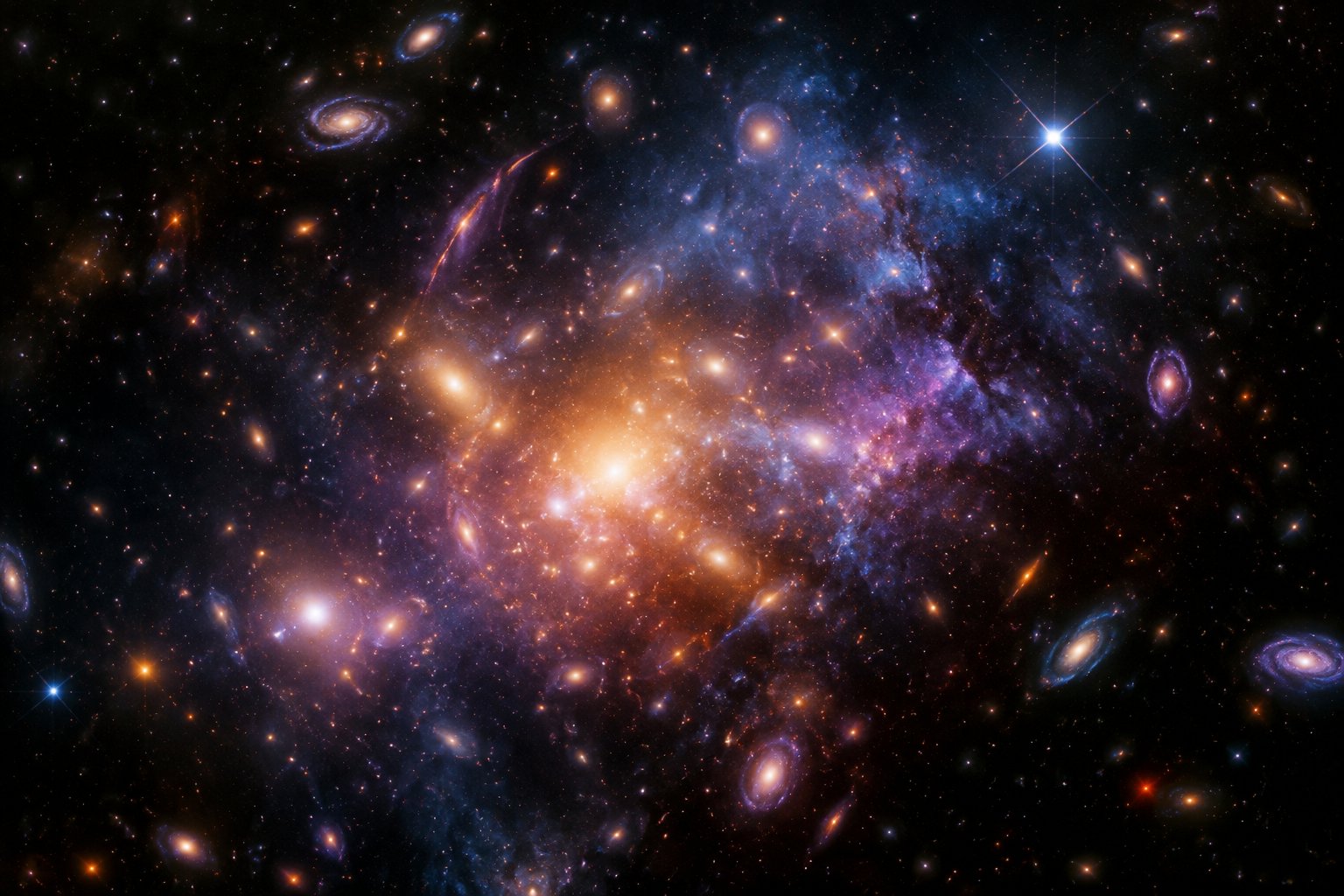
Dense young star clusters imaged by the James Webb Space Telescope (JWST) could plausibly form intermediate-mass black holes through repeated stellar collisions, researchers report. In a story published on November 4, 2026, Cosmic Herald describes a study of clusters in two gravitationally lensed early-universe systems, the Cosmic Gems arc and Firefly Sparkle. The estimates point to possible black holes of roughly 100 to 4,000 times the Sun’s mass—but the models do not show that black holes have been detected in either system.
What the researchers modeled
The study, led by Viola Bocchi of Sapienza University of Rome with co-authors Liempi and Schleicher, examines compact young clusters that JWST resolved in the two systems. Universe Today reported on November 2 that the clusters span about 100,000 to 10 million solar masses and have half-mass radii of roughly 0.4 to 15 parsecs. A parsec is a unit of astronomical distance; a cluster’s half-mass radius describes the region containing half its total mass.
The Cosmic Gems arc is seen at a redshift of about 10.2, corresponding to roughly 460 million years after the Big Bang, and contains five clusters. Firefly Sparkle, at a redshift of about 8.3, is seen around 600 million years after the Big Bang and contains ten. Redshift describes how much the expansion of the universe has stretched light on its journey to us. Both systems are magnified by foreground gravitational lenses: the gravity of objects between them and Earth bends and magnifies their light, making individual clusters easier to distinguish.
To estimate what could happen inside the clusters, the team modeled runaway collisions. Gravitational interactions can cause massive stars to gather toward a cluster’s center. In a sufficiently crowded core, stars may collide and merge; the resulting more massive star can then become a target for further collisions. The model estimates that this process could build a very massive star that later collapses into a black hole.
Cosmic Herald reports that the researchers used a Fokker-Planck model—a statistical method for describing how a cluster’s stars change over time—alongside an analytic framework for collisions. They checked the framework against N-body simulations, which follow individual stellar orbits. According to Universe Today, the resulting typical black-hole estimates are about 100 to 4,000 solar masses, with a formation efficiency of a few percent of the cluster’s stellar mass.
The proposed seeds are not observed black holes
The estimates differ between the two systems. Universe Today reports that the more compact Cosmic Gems clusters, with half-mass radii around one parsec, could produce black holes of roughly 1,600 to 2,700 solar masses. The more extended Firefly Sparkle clusters, with radii of about four to six parsecs, yield estimates of roughly 180 to 810 solar masses. The researchers’ explanation is that compact clusters have denser centers, where stellar collisions are more likely.
There is also a condition on the proposed pathway: the study finds that low metallicity is important. Metallicity is the abundance of elements heavier than hydrogen and helium. Cosmic Herald and Universe Today report that the modeled clusters need metallicities below roughly two percent of the Sun’s. In the researchers’ account, lower metallicity helps massive stars retain more of their mass against stellar winds, making it easier for a collision-built star to grow.
These are estimates based on cluster properties inferred from magnified images, not detections of intermediate-mass black holes in the clusters. Universe Today notes that properties such as the clusters’ internal structure and rotation are not known and could affect the results. The study therefore identifies a plausible route, not confirmation that these particular clusters produced black holes.
Why a heavy seed could matter
The proposal addresses a timing challenge in black-hole research: supermassive black holes are observed in the early universe, leaving researchers to explain how they could grow so large so quickly. One possible starting point is a “heavy seed”—a black hole already much more massive than the remnant of a single ordinary star. If some early clusters could make seeds of hundreds or thousands of solar masses, those objects would have more mass from which to grow. That would make the route to early supermassive black holes more plausible, but would not establish that this is how they formed.
Intermediate-mass black holes, generally described as about 100 to 100,000 solar masses, are an important part of that picture because they sit between stellar-mass and supermassive black holes. Universe Today points to two earlier pieces of evidence: a 2024 study reporting an approximately 8,200-solar-mass black hole in Omega Centauri, and a 2020 gravitational-wave merger in which black holes of 85 and 66 solar masses produced a remnant of about 142 solar masses.
A separate line of work offers a related, but distinct, possibility. Cosmic Herald reports that Space.com covered simulations by a UCLA team including Claire Williams and Smadar Naoz. Those models also examine repeated collisions in dense early star clusters and suggest that compact JWST sources nicknamed “Little Red Dots” could be clusters of this kind. The studies use different methods and address different observed targets; neither report establishes that the Little Red Dots are such clusters or that they contain these proposed seeds.
Background and what to watch next
Universe Today describes the Bocchi-led study as published in Astronomy & Astrophysics, while Cosmic Herald says it was accepted for publication there. Both accounts describe the same central result: modeling suggests the JWST-resolved clusters could form intermediate-mass black holes through stellar collisions. The distinction matters because the result is a modeled formation pathway, not a report of a newly detected black hole.
The next step identified in the reporting is observational: detect black holes themselves, or signs that they are growing, in clusters like these. Until then, the useful takeaway is measured but significant. JWST has revealed early star clusters with properties that make heavy-seed formation plausible under the model’s conditions; whether those environments actually made black holes remains an open question.
Source: universetoday.com
More sources (1)
More from the Observatory
 Black holes
A gap in black-hole masses hints at stars that vanished without exploding
A Caltech-led analysis of 257 black-hole mergers found a shortage of objects between 12 and 16 solar masses. The pattern is consistent with a proposed failed-supernova channel, but it is not a direct observation of one.
Maya Ellison · Nov 19, 2026 · 4 min read
 Stars and galaxies
A Possible Atmosphere on TOI-431b, Seen in a Partial Eclipse
A JWST observation of the ultrahot rocky planet TOI-431b points to a possible atmosphere, but one partial eclipse cannot reveal its composition.
Maya Ellison · Nov 18, 2026 · 4 min read
 Deep space and cosmology
SN Ares: JWST finds a supernova whose next images may take decades
JWST observations reveal the lensed Type IIb supernova SN Ares. Models predict two more images decades from now, but those arrivals—and their timing—remain to be observed.
Maya Ellison · Nov 17, 2026 · 4 min read