
A Possible Atmosphere on TOI-431b, Seen in a Partial Eclipse
A JWST observation of the ultrahot rocky planet TOI-431b points to a possible atmosphere, but one partial eclipse cannot reveal its composition.

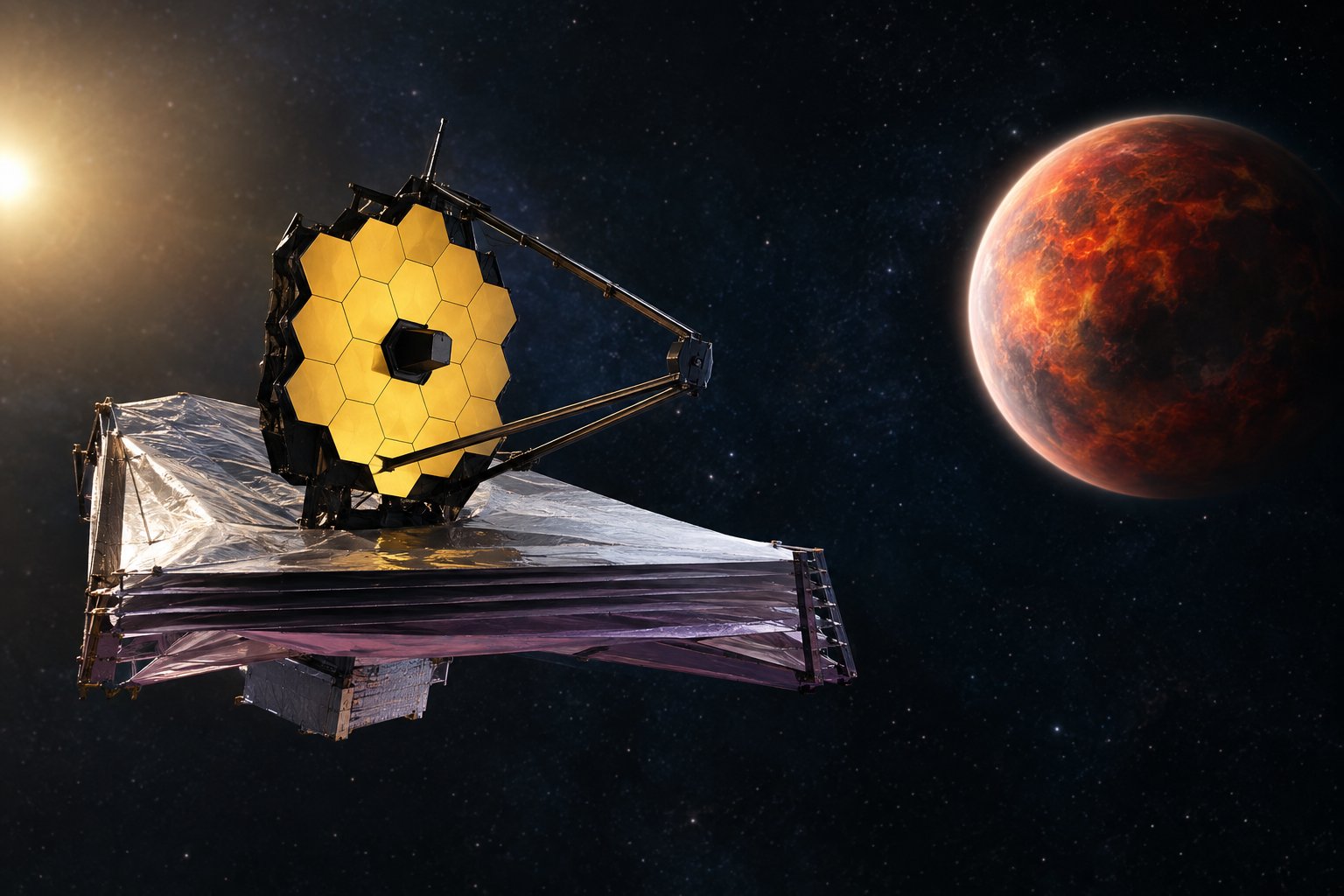
A JWST observation of the ultrahot rocky planet TOI-431b has produced evidence consistent with a possible atmosphere, Astrobiology Web reported on Nov. 15, 2026. Using the MIRI/LRS mid-infrared spectrograph, researchers measured part of the planet’s secondary eclipse. The result points toward an atmosphere, but it does not identify what gases may be present.
What the observation measured
A secondary eclipse occurs when a planet passes behind its star from our viewpoint, briefly hiding the planet’s dayside glow. Measuring the change in light during that passage lets researchers estimate the planet’s thermal emission. The observation of TOI-431b captured only part of an eclipse, rather than a complete one.
Astrobiology Web reported an eclipse depth of 81 ± 16 parts per million. From that signal, the researchers derived a brightness temperature of 1967 kelvin, with an uncertainty of minus 253 and plus 237 kelvin. Brightness temperature is the temperature inferred from the planet’s thermal emission; it is not a direct measurement of the planet’s surface temperature.
The report also gives a brightness temperature ratio, R, of 0.81 ± 0.10. That value is 1.2 standard deviations higher than the ratio previously reported by Spitzer for TOI-431b. It is also 1.8 standard deviations below the value of 1 expected for a bare rock with zero albedo and zero heat redistribution. Albedo means reflectivity; heat redistribution here refers to heat being moved away from the planet’s dayside.
Why researchers interpret it as a possible atmosphere
An atmosphere can affect a rocky planet’s eclipse signal in more than one way: it may raise the planet’s albedo, or carry heat away from the dayside. Either effect can lower the measured eclipse depth compared with a bare-rock case. That makes secondary-eclipse thermal emission a way to look for evidence of an atmosphere, though the signal is an indirect one.
For comparison, the bare-rock benchmark described in Astrobiology Web’s report assumes no reflectivity and no day-to-night heat transport. The researchers expect magma pools to have low albedos. They therefore interpret the measured ratio as best explained by an atmosphere, rather than by a low-albedo molten surface alone. This is the researchers’ interpretation of the observation, not a direct identification of atmospheric gases.
Why this matters for lava worlds
TOI-431b is described in the report as an ultrahot rocky lava planet. Lava worlds are rocky planets so hot that their surfaces can hold liquid magma, and planets orbiting extremely close to their stars face intense heating. Whether such worlds can retain significant atmospheres remains an open question in exoplanet science.
Earlier eclipse observations of lava planets have also suggested atmospheres, according to Astrobiology Web. The TOI-431b result adds another case to that developing sample. For readers following JWST’s study of planets beyond our solar system, the distinction matters: the observation offers a clue about an atmosphere, while the underlying question of how these intensely heated rocky worlds retain gaseous envelopes remains unresolved.
The finding was reported in connection with an open-access paper in The Astronomical Journal, titled “JWST MIRI Reveals a Potential Atmosphere on the Ultrahot Rocky Planet TOI-431b.” Its focus is whether strongly irradiated rocky planets can hold on to gaseous envelopes.
What remains to be established
The reported observation does not establish the atmosphere’s composition. Astrobiology Web says the researchers identify determining that composition, and improving models of lava-planet atmospheres, as work still to be done. Those steps could help constrain the nature and evolution of lava planets, but the current measurement alone cannot say which gases TOI-431b may have.
For now, the evidence is a single partial eclipse whose measured signal the researchers interpret as best explained by an atmosphere. Whether TOI-431b can retain a substantial gaseous envelope, and what that envelope contains, remain open questions.
Source: orbital-wire.com
More from the Observatory
 Black holes
A gap in black-hole masses hints at stars that vanished without exploding
A Caltech-led analysis of 257 black-hole mergers found a shortage of objects between 12 and 16 solar masses. The pattern is consistent with a proposed failed-supernova channel, but it is not a direct observation of one.
Maya Ellison · Nov 19, 2026 · 4 min read
 Deep space and cosmology
SN Ares: JWST finds a supernova whose next images may take decades
JWST observations reveal the lensed Type IIb supernova SN Ares. Models predict two more images decades from now, but those arrivals—and their timing—remain to be observed.
Maya Ellison · Nov 17, 2026 · 4 min read
 Black holes
Two black-hole signals put detector calibration in focus
The LIGO-Virgo-KAGRA Collaboration announced two binary black-hole detections and an informative application of astrophysical calibration. The reported signal-to-noise ratios were 32 for GW240925 and 69 for GW250207.
Maya Ellison · Nov 17, 2026 · 4 min read