
SN Ares: JWST finds a supernova whose next images may take decades
JWST observations reveal the lensed Type IIb supernova SN Ares. Models predict two more images decades from now, but those arrivals—and their timing—remain to be observed.

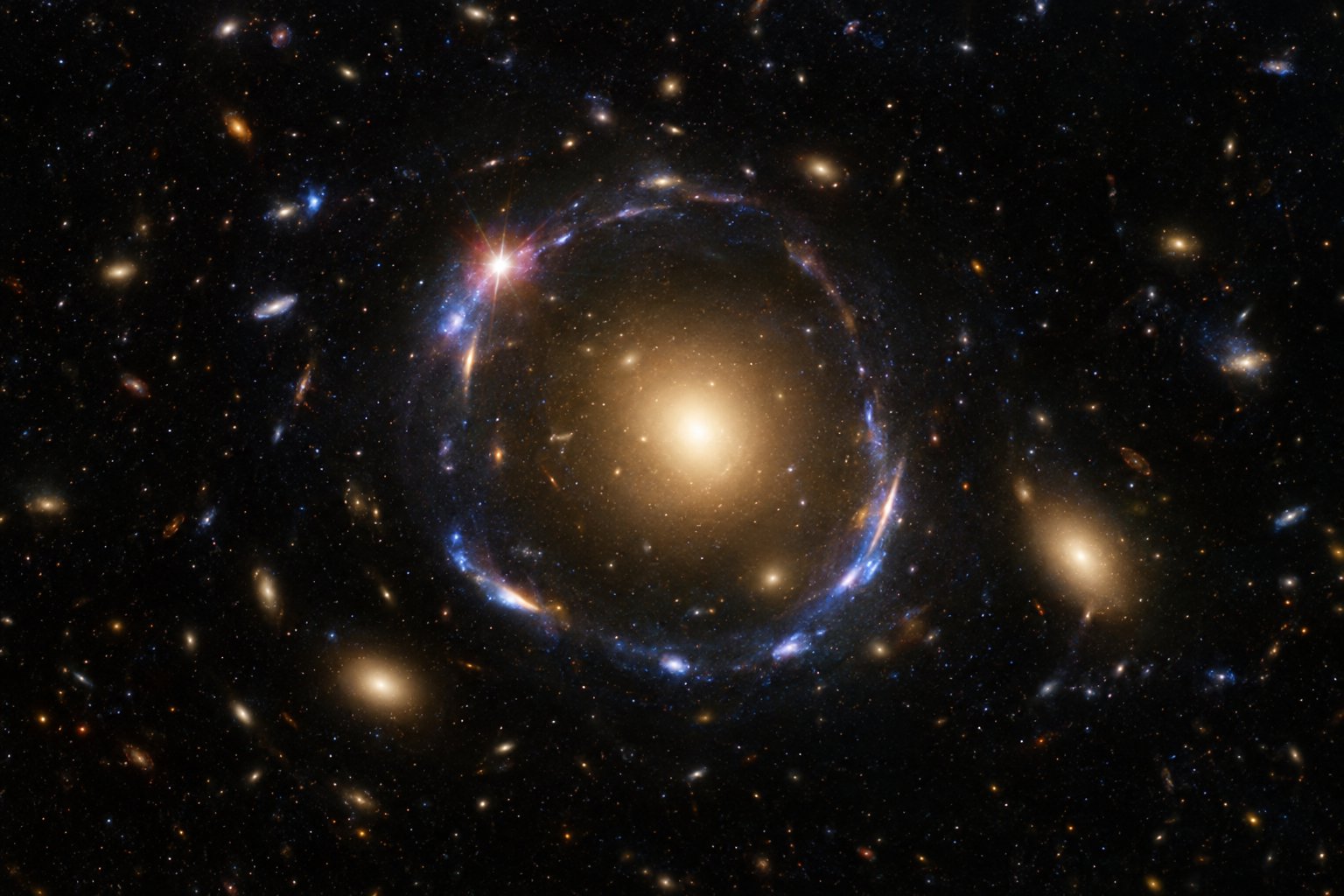
Astronomers using the James Webb Space Telescope (JWST) have detected SN Ares, a distant supernova whose light has been magnified and split by the gravity of a galaxy cluster. The team led by Conor Larison at the Space Telescope Science Institute found it in August 2025; according to Orbital Wire, three lens models predict that two more images of the explosion will reach Earth in roughly 73 and 76 years.
What the team observed
The discovery came from JWST near-infrared images of the galaxy cluster field MACS J0308.9+2645. The cluster lies between Earth and the supernova. Its gravity bends and magnifies light from behind it, allowing astronomers to see SN Ares as a lensed image. Orbital Wire reports that astronomers currently observe one magnified image of the event; the two additional images are predictions, not detections.
The explosion occurred about 8.8 billion years ago, when the universe was 4.9 billion years old, according to the report. JWST spectroscopy—analysis of the light separated into its component wavelengths—showed signatures of helium and hydrogen. Researchers interpret those features as evidence that the star had lost most of its outer hydrogen layer before it exploded. On that basis, they classify SN Ares as a Type IIb supernova.
Orbital Wire reports that the team describes SN Ares as the highest-redshift member of its class identified through spectroscopy. Redshift describes how light is shifted toward longer wavelengths; here, the reported classification rests on the observed helium and hydrogen features. The discovery paper, titled SN Ares: A Strongly Lensed Type IIb Supernova at z=1.276 with a Predicted 70-Year Time Delay, appeared on the arXiv preprint server on October 23, 2026.
Why the delayed images matter
A gravitational lens can produce multiple images because light from the same distant source travels along different paths around a massive object. Those paths are not equal in length, so the images can arrive at different times. Orbital Wire says the gaps between lensed images can range from hours to decades; for SN Ares, the models forecast unusually long waits.
The predicted delays are scientifically useful because the time between images depends on the geometry of space. The research team says that measuring a delay can help constrain the Hubble constant, the rate at which the universe is expanding, as well as other cosmological parameters linked to expansion. That is a potential use of a future measurement, not a result already obtained from SN Ares: the later images have not arrived, and the delay has not yet been measured.
Orbital Wire reports that, using a 70-year assumed timeline, the team describes SN Ares as having the largest predicted delays among discovered lensed supernova systems. The distinction is about a model-based forecast. It does not mean that astronomers have observed the full sequence or confirmed the eventual arrival times.
A natural lens, not a direct view
The cluster acts as a natural gravitational lens: its mass bends light from the more distant supernova and can create multiple distorted images. The images are different routes taken by light from the same event, rather than separate explosions. The timing forecasts depend on models of the lens and the paths that light follows.
That makes SN Ares a striking case for readers interested in distant cosmic events: one explosion may be observed in stages separated by many decades. But the long interval is not an observed feature yet. At present, the evidence described by Orbital Wire is the detected, magnified image and the spectral signatures used to classify the supernova; the later appearances remain predictions.
Publication date and what comes next
The team’s paper appeared on arXiv on October 23, 2026, after the August 2025 detection. Orbital Wire reports that the researchers intend to carry out more spectroscopic redshift measurements in early 2027. They expect this work to improve their understanding of the lens and refine the predicted delays.
The next major test will be whether the additional images arrive as forecast. If astronomers can observe them, comparing their arrival times could provide a measurement relevant to the universe’s expansion. For now, the timing estimates are model-based, and the report does not give confirmed calendar dates for the predicted appearances.
Source: orbital-wire.com
More from the Observatory
 Black holes
A gap in black-hole masses hints at stars that vanished without exploding
A Caltech-led analysis of 257 black-hole mergers found a shortage of objects between 12 and 16 solar masses. The pattern is consistent with a proposed failed-supernova channel, but it is not a direct observation of one.
Maya Ellison · Nov 19, 2026 · 4 min read
 Stars and galaxies
A Possible Atmosphere on TOI-431b, Seen in a Partial Eclipse
A JWST observation of the ultrahot rocky planet TOI-431b points to a possible atmosphere, but one partial eclipse cannot reveal its composition.
Maya Ellison · Nov 18, 2026 · 4 min read
 Black holes
Two black-hole signals put detector calibration in focus
The LIGO-Virgo-KAGRA Collaboration announced two binary black-hole detections and an informative application of astrophysical calibration. The reported signal-to-noise ratios were 32 for GW240925 and 69 for GW250207.
Maya Ellison · Nov 17, 2026 · 4 min read