
Latest Black Hole Discoveries: A Wandering Giant, a Hidden Companion and a Growing Quasar
Recent reports trace black holes through a star-shredding flare, a star’s precise motion, a Webb spectrum and an unusually fast-growing early-universe quasar. Here is what the evidence supports—and what remains a model.

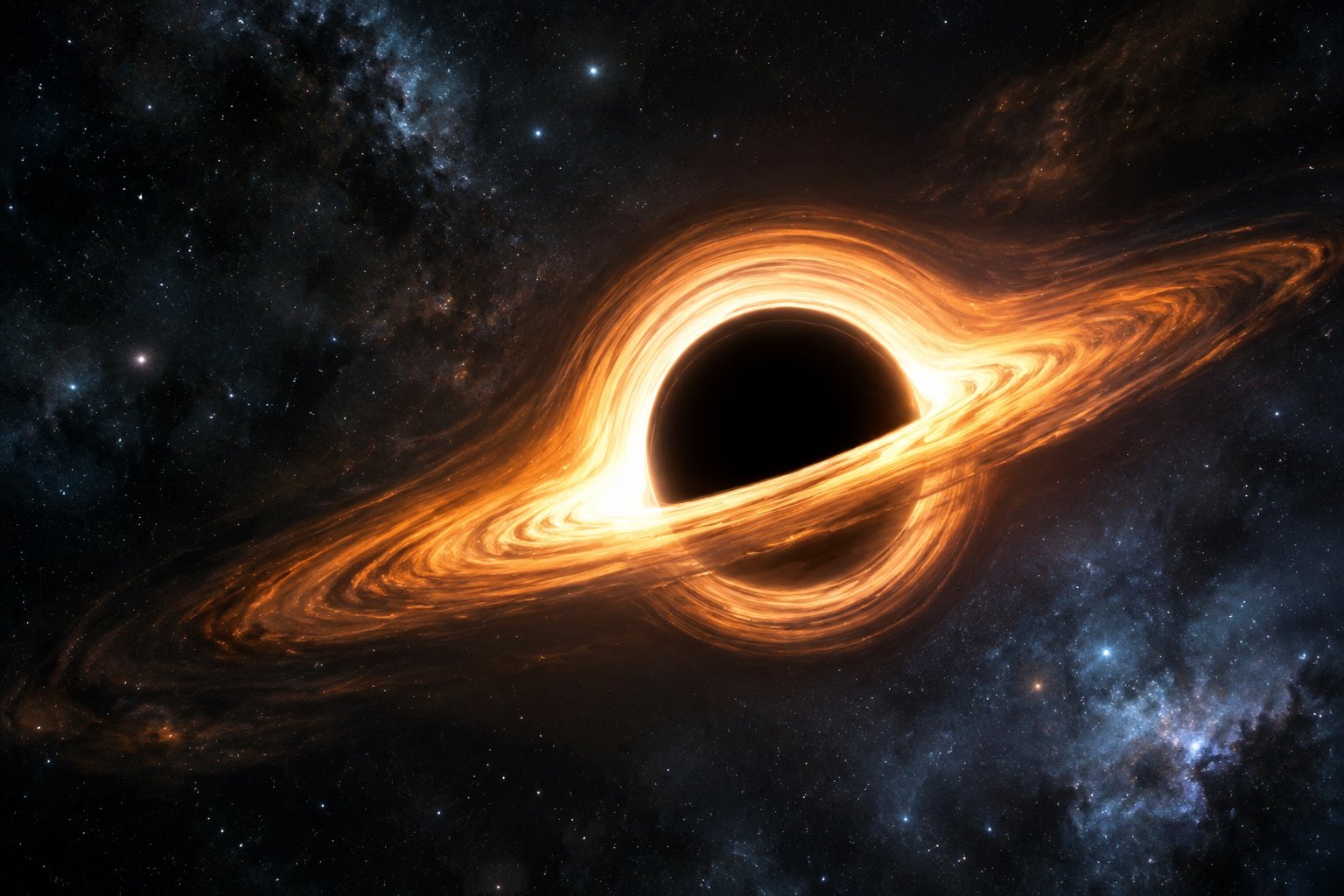
NASA reported on July 27, 2026, that its Swift observatory had helped identify a rare star-shredding flare from a supermassive black hole far from the centre of its host galaxy. That finding joins recent results from Hubble, Webb and Chandra: researchers have identified a stellar-mass black hole in Omega Centauri, found evidence supporting a proposed “black hole star” model for a distant Webb target, and measured signs of exceptionally rapid growth in an early-universe quasar. These observations reveal different ways to find black holes; they do not settle every question about how such objects form.
What researchers observed
A flare far from a galaxy’s core
NASA says the Neil Gehrels Swift Observatory studied a flare produced when a star passed too close to a black hole and was torn apart by gravity. Astronomers call this a tidal disruption event. The black hole is estimated to have about a million times the Sun’s mass, and it lies in the outskirts of a galaxy about 750 million light-years away. The Zwicky Transient Facility first flagged an unusual brightening there in November 2025.
The flare briefly outshone its entire host galaxy in ultraviolet light, radiating for a few months with the light of about 10 billion Suns. The event’s location made it unusual: NASA reported that such events are rare and that none had previously been seen so far from a galaxy’s core. Observations from the SOAR telescope helped researchers examine the flare’s spectrum, while Swift’s Ultraviolet/Optical Telescope measured a temperature of about 54,000 degrees Fahrenheit (30,000 degrees Celsius). NASA says the combined evidence supported the interpretation that the flare was a tidal disruption event.
An artificial-intelligence algorithm helped flag the unusual flare among the Zwicky Transient Facility’s detections. NASA reported that the survey detects about half a million flashes each night; the algorithm identified this one as resembling a tidal disruption event despite its position in the galaxy’s outskirts. NASA’s account of the Swift finding quotes study leader Robert Stein saying the team hopes to use the method to search for more wandering black holes.
A black hole in Omega Centauri
In a report dated July 13, 2026, NASA described the first detected stellar-mass black hole in the globular star cluster Omega Centauri. The team combined more than 20 years of Hubble observations with recent Webb data to track the small movements of a visible star. That motion showed the star orbiting an unseen companion. The researchers estimated the companion’s mass at 4.46 times the Sun’s, too high for it to be a neutron star, and identified it as a black hole. The system is about 18,000 light-years away.
This method, called astrometry, measures a star’s position and motion over time. NASA says the finding refines an earlier study that had suggested the companion might be a neutron star. The black hole has a visible star companion, and the pair’s orbital period is reported to be the longest known for a black-hole binary system.
Webb’s spectrum and the “black hole star” model
NASA reported on June 10, 2026, that Webb observations of GLIMPSE-17775 provide the strongest evidence yet for one explanation of the mysterious “little red dots”: a supermassive black hole surrounded by a dense cocoon of partly ionized gas. Researchers call this proposed interpretation the black hole star, or BH*, scenario. The object is behind the galaxy cluster Abell S1063, and its light has been magnified by gravitational lensing, an effect that makes a distant object appear brighter.
The team analysed a 30-hour Webb spectrum, with the lensing effect making the observation equivalent to 80 hours of telescope time. NASA reports that the spectrum contains more than 40 spectral lines, the most detailed spectrum of a little red dot to date. GLIMPSE-17775 has a redshift of 3.5, meaning the light we see was emitted when the universe was about 1.8 billion years old. This is evidence supporting the BH* model for this object—not a settled explanation for all little red dots. The wider question of how Little Red Dots might form remains an active area of research.
An early quasar growing at an unusual rate
A September 18, 2025, NASA report on Chandra observations described RACS J0320-35, a quasar powered by a black hole estimated to contain about a billion solar masses. Astronomers see it as it was about 920 million years after the universe began. Chandra data indicated that the black hole may be growing faster than the usual limit for accretion, the process in which matter falls towards a black hole.
That benchmark is called the Eddington limit: radiation from heated infalling matter creates pressure that normally balances gravity and restricts how quickly more matter can fall in. The team estimated a growth rate of between 300 and 3,000 solar masses per year and said the rate could be about 2.4 times the Eddington limit. Those are estimates, and NASA’s report frames the interpretation conditionally: if the black hole has sustained such rapid growth, it may have started from a more conventional, lower-mass seed rather than an unusually massive one. The observation therefore informs competing ideas about how early black holes reached enormous masses; it does not establish which formation pathway is correct.
NASA’s Chandra report says the team had discovered the quasar two years earlier, but observations made in 2023 revealed what set it apart.
Why these results matter
Together, the reports show why black-hole research relies on more than one kind of evidence. A flare can reveal a black hole feeding on a star; precise measurements of a companion star’s movement can expose an otherwise invisible object; a spectrum can test what may be powering a distant source; and X-ray observations can help estimate how quickly a quasar is growing. Each method answers a different question, and each conclusion depends on interpreting measurements rather than seeing the black hole itself.
The findings also span very different settings: a black hole in a nearby star cluster, a flare in a galaxy’s outskirts, a distant Webb target and a quasar in the young universe. For readers following early black-hole origins, the Chandra result is especially relevant because its implications for the black hole’s birth depend on whether unusually rapid growth persisted. For readers interested in Webb’s little red dots, the key distinction is between a detailed spectrum that supports one model and a definitive explanation of the whole population.
Dates and context
How the findings unfolded
- Chandra observes RACS J0320-35
The X-ray observations later revealed evidence of unusually rapid growth in the quasar’s black hole.
- NASA reports the Chandra result
The report discusses the estimated growth rate and what it could imply for the black hole’s birth.
- A survey flags the distant flare
The Zwicky Transient Facility detects an unusual brightening in the outskirts of a galaxy about 750 million light-years away.
- NASA reports Webb’s GLIMPSE-17775 spectrum
Researchers describe evidence supporting the black hole star model for this little red dot.
- NASA reports the Omega Centauri black hole
Hubble and Webb measurements of a star’s motion identify its unseen companion as a stellar-mass black hole.
- NASA reports the Swift tidal disruption event
The flare provides a way to identify a black hole far from its galaxy’s core.
What to watch next
The Swift team’s stated next aim is to use this technique to search for more wandering supermassive black holes. The result is notable as one of only a small number of such far-out events that NASA says have been confirmed. For the other findings, the reports describe published research and the evidence collected so far; they do not give a specific date for a next observation or decision. The key questions remain whether more outlying flares can be identified, how the Omega Centauri system compares with other black-hole binaries, and whether the proposed Webb interpretation and the estimated rapid growth of early quasars hold up as researchers study additional objects.
Source: science.nasa.gov
More sources (4)
More from the Observatory
 Black holes
A gap in black-hole masses hints at stars that vanished without exploding
A Caltech-led analysis of 257 black-hole mergers found a shortage of objects between 12 and 16 solar masses. The pattern is consistent with a proposed failed-supernova channel, but it is not a direct observation of one.
Maya Ellison · Nov 19, 2026 · 4 min read
 Stars and galaxies
A Possible Atmosphere on TOI-431b, Seen in a Partial Eclipse
A JWST observation of the ultrahot rocky planet TOI-431b points to a possible atmosphere, but one partial eclipse cannot reveal its composition.
Maya Ellison · Nov 18, 2026 · 4 min read
 Deep space and cosmology
SN Ares: JWST finds a supernova whose next images may take decades
JWST observations reveal the lensed Type IIb supernova SN Ares. Models predict two more images decades from now, but those arrivals—and their timing—remain to be observed.
Maya Ellison · Nov 17, 2026 · 4 min read