
Could Ancient Star Collisions Explain Little Red Dots?
Simulations suggest that repeated mergers in dense early-universe star clusters could create massive stars and black-hole seeds. The proposed link to JWST’s Little Red Dots remains an interpretation, not a confirmed explanation.

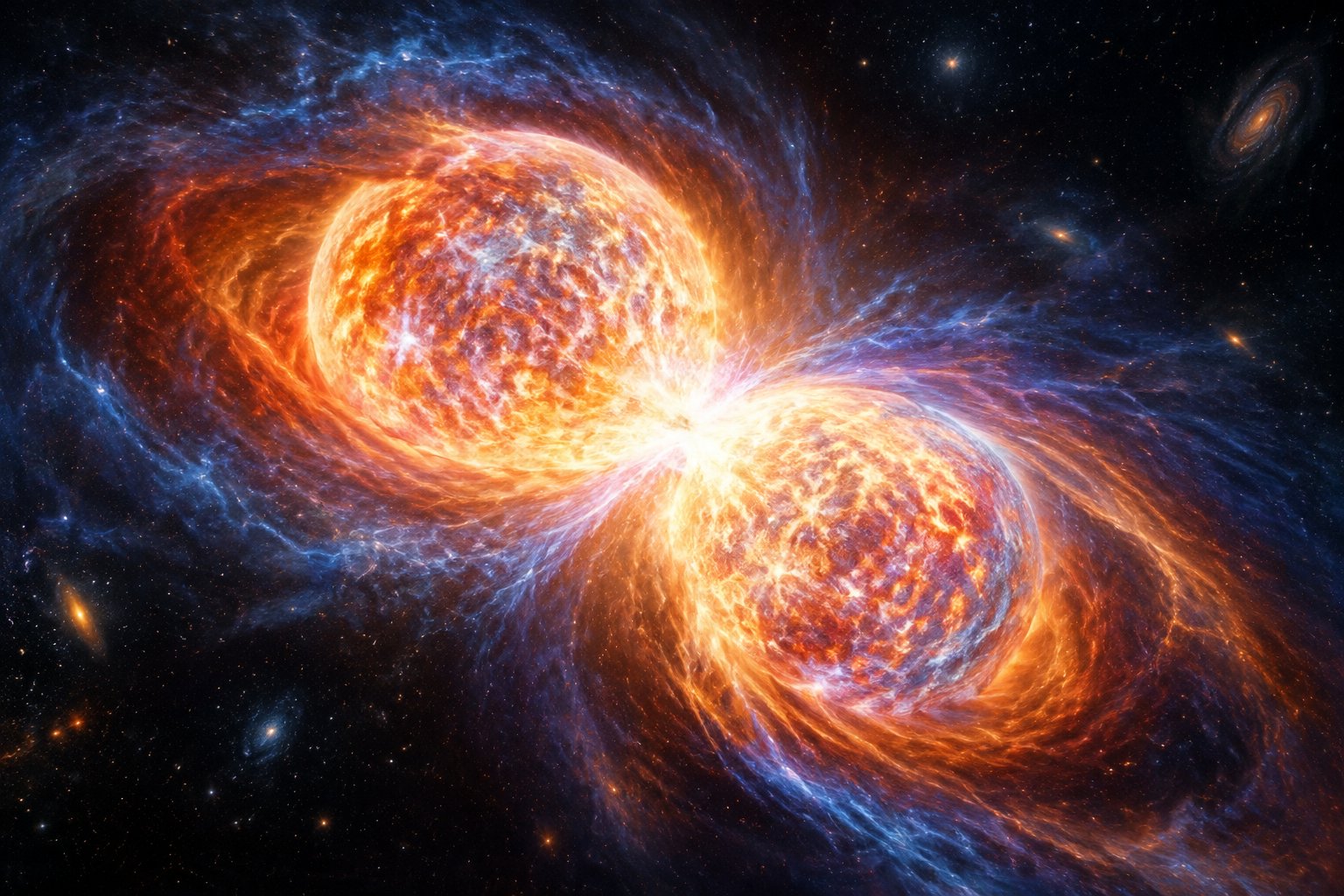
Simulations of the early universe suggest that crowded star clusters may have enabled repeated stellar collisions, building extremely massive stars that could later collapse into black holes. The research, published in The Astrophysical Journal on Oct. 26, offers a possible route to the black-hole seeds that grew into supermassive black holes, and a possible explanation for some of the compact objects JWST sees as Little Red Dots. Space.com and Yahoo Tech reported the findings on Nov. 3, 2026; the proposed connection is a model, not a confirmed account of what those objects are.
How collisions could build a black-hole seed
The researchers simulated star systems in the early universe and found that dense environments could bring stars into frequent collisions. The outcome, their model suggests, depends on how fast the stars meet. Rapid collisions would destroy the stars involved; slower encounters could instead allow repeated mergers. Over time, those mergers might produce a single star far more massive than an ordinary star.
At the end of its life, such a star could collapse into a black hole larger than one formed from the collapse of a typical massive star. In the proposed scenario, that black hole would act as a seed: an early starting point from which a supermassive black hole could grow. The simulations do not establish that this sequence occurred in every early cluster, or that a particular observed object formed this way.
Claire Williams, a member of the research team at the University of California, Los Angeles, described the model’s most extreme result: “Perhaps the strangest outcome of our simulations is that stars can merge repeatedly within the cluster until they form one gigantic star with a mass equal to that of an entire cluster.” She added that models suggest such a star could collapse into a massive black hole at the end of its life.
Why Little Red Dots enter the picture
JWST has found compact objects in the early universe known as Little Red Dots, named for their appearance. Their nature is unsettled: researchers have proposed different explanations, including the possibility that they contain rapidly growing black holes. The simulations offer another way to connect the dots: a dense, collision-filled star cluster could appear as a Little Red Dot while mergers build a massive star, which later collapses into an intermediate-mass black hole.
An intermediate-mass black hole is a proposed size class between stellar-mass black holes and supermassive ones. The reports describe stellar-mass black holes as roughly 10 to 100 times the Sun’s mass, and intermediate-mass black holes as roughly 100 to 100,000 solar masses. Supermassive black holes can reach millions or billions of solar masses. The proposed cluster pathway could therefore give black-hole growth a more massive starting point than the collapse of a single ordinary star.
For readers following JWST clusters proposed as black-hole seed sites, the connection is a useful one to track: the same general setting of young, dense clusters is being explored as a possible place for heavy seeds to form. But a simulation-based explanation and an observed object are different kinds of evidence.
The early universe was not today’s galactic centre
One reason the scenario matters is the apparent speed at which some supermassive black holes formed. Space.com and Yahoo Tech report that JWST observations have found such black holes when the universe was less than 1 billion years old. Their growth is a puzzle because the feeding and merger processes associated with reaching millions or billions of solar masses are expected to take substantial time. A heavier initial seed could give that growth a head start.
The early universe’s conditions differed from those in present-day galaxy centres. The reports describe it as containing dense, chaotic regions of star formation. In contrast, dense stellar environments still found at the hearts of modern galaxies are shaped by existing supermassive black holes. Their gravity speeds up the orbits of nearby stars, making collisions that do occur more destructive and less likely to produce the massive merged stars in this model.
The proposal may also help address why Little Red Dots seem to disappear by the time the universe was about 2 billion years old. The researchers suggest that as the universe expanded and cooled, chaotic star-forming sites became building blocks of more orderly galaxies. If Little Red Dots are associated with those temporary cluster conditions, their apparent disappearance could reflect the end of the conditions that sustained them. That remains conditional on the proposed identification being right.
What the evidence supports—and what remains open
The central result reported by Space.com and Yahoo Tech is that simulations produced repeated mergers in dense early star clusters, potentially creating stars massive enough to collapse into black holes. This makes stellar collisions a candidate explanation for both heavy black-hole seeds and the nature of Little Red Dots; it does not show that astronomers have directly observed these collisions or confirmed that all Little Red Dots are star clusters.
Smadar Naoz, a UCLA researcher on the team, said the work connects several interpretations of Little Red Dots. Her comparison is apt: the objects remain difficult to characterize, and the reported model is one proposed way to bring different perspectives together, not a settled identification.
The research was published in The Astrophysical Journal on Oct. 26, as reported by both publishers. The next point to follow is whether the cluster-and-collision scenario can account for the observed objects and black-hole growth while remaining consistent with other explanations. The reports do not identify a forthcoming decision or an announced follow-up date. For now, the careful reading is that early star collisions may offer a route to massive seeds—not that the origin of Little Red Dots or supermassive black holes has been resolved.
Source: space.com
More sources (1)
More from the Observatory
 Black holes
A gap in black-hole masses hints at stars that vanished without exploding
A Caltech-led analysis of 257 black-hole mergers found a shortage of objects between 12 and 16 solar masses. The pattern is consistent with a proposed failed-supernova channel, but it is not a direct observation of one.
Maya Ellison · Nov 19, 2026 · 4 min read
 Stars and galaxies
A Possible Atmosphere on TOI-431b, Seen in a Partial Eclipse
A JWST observation of the ultrahot rocky planet TOI-431b points to a possible atmosphere, but one partial eclipse cannot reveal its composition.
Maya Ellison · Nov 18, 2026 · 4 min read
 Deep space and cosmology
SN Ares: JWST finds a supernova whose next images may take decades
JWST observations reveal the lensed Type IIb supernova SN Ares. Models predict two more images decades from now, but those arrivals—and their timing—remain to be observed.
Maya Ellison · Nov 17, 2026 · 4 min read