
A gap in black-hole masses hints at stars that vanished without exploding
A Caltech-led analysis of 257 black-hole mergers found a shortage of objects between 12 and 16 solar masses. The pattern is consistent with a proposed failed-supernova channel, but it is not a direct observation of one.

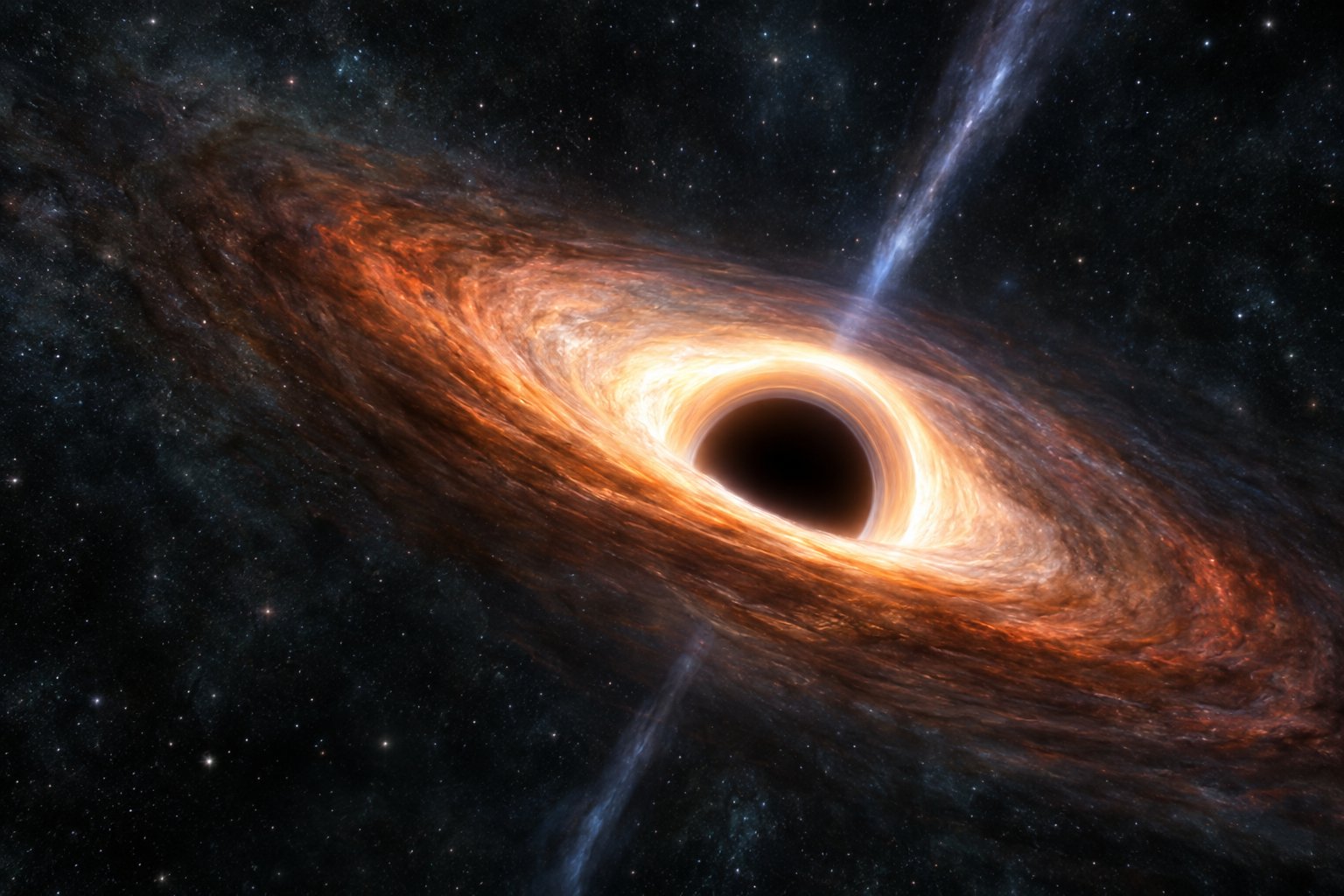
A Caltech-led team has found a shortage of black holes with masses between 12 and 16 times the Sun’s mass in a study of 257 black-hole mergers detected by the LIGO–Virgo–KAGRA network. The researchers report that the pattern is consistent with the idea that some black holes form when massive stars collapse without a supernova explosion. It is evidence from gravitational-wave data, not a direct observation of a star failing to explode, Orbital Wire reported.
What the merger data show
As Orbital Wire reported, the team examined the mass distribution of 257 black-hole mergers recorded by the international gravitational-wave network over the past 10 years. About 75 percent of the sample formed a peak at 10 solar masses. A solar mass is the mass of the Sun.
The researchers also found a distinct shortage of black holes in the range from 12 to 16 solar masses. That gap was not predicted by the earlier models discussed in the report. The finding describes a pattern in the observed merger population; it does not mean that black holes in this mass range cannot exist.
The study also compared spin rates. According to Orbital Wire, the 10-solar-mass black holes occupied a narrower range of spins than the wider sample. Since how a black hole forms can influence its spin, the researchers viewed this tighter range as support for the possibility that these objects share a formation history.
How a failed supernova could fit
In the standard picture described by Orbital Wire, a massive star’s core collapses, shockwaves hit its outer layers and trigger a supernova, while the collapsed core becomes a black hole. A failed supernova follows a different proposed path: the star collapses but does not explode, leaving it to disappear from view. The resulting black hole would not be marked by the visible explosion that normally helps astronomers identify a supernova.
Theories allow for massive stars to collapse directly into neutron stars or black holes. Earlier research had found that merging black holes often have masses around 10 solar masses, and theorists had proposed that this population could include objects formed by failed supernovae. The Caltech-led team tested whether that proposal was consistent with the gravitational-wave observations.
If this formation channel is correct, either the heavier black hole in a merging pair or both members could have originated in stars that collapsed without exploding. The mass and spin patterns are compatible with that possibility, but they do not establish the history of any individual black hole.
Why the result matters—and what it does not establish
For black-hole research, the result offers a way to connect merger measurements with the lives and deaths of the stars that may have produced the merging objects. Orbital Wire reported that Katerina Chatziioannou, who led the research, said the findings connect gravitational-wave data with underlying astrophysics. For readers following gravitational-wave detections, the central point is that a population-level pattern can help researchers test ideas about black-hole origins.
The evidence remains indirect. Orbital Wire reported that no failed supernova has been directly observed and that the study’s conclusion rests on gravitational-wave statistics and theoretical expectations. A shortage in a mass distribution can be consistent with a proposed explanation without showing that explanation is the only one, or confirming that a particular star vanished in this way.
The report also quoted lead author Isaac Legred as saying, “We see 10-solar-mass black holes merging all the time.” That observation describes the recurring population discussed in the study; the proposed failed-supernova origin still requires further research.
Date, context and what comes next
Orbital Wire reported that the paper, “Low-mass failed supernovae and the 10 M ⊙ peak in the merging black hole mass distribution,” appeared in Physical Review D on November 10, 2026. The analysis draws on detections by LIGO, Virgo and KAGRA. LIGO made the first direct detection of gravitational waves in 2015, from colliding black holes; Virgo and KAGRA later joined the network, which the report says has logged more than 300 black-hole collisions.
The next step identified in the report is further research to assess whether failed supernovae explain the pattern. Legred said more work is needed to confirm that formation channel. Until then, the mass gap is a clue to investigate, not a direct sighting of a failed supernova.
Source: orbital-wire.com
More from the Observatory
 Stars and galaxies
A Possible Atmosphere on TOI-431b, Seen in a Partial Eclipse
A JWST observation of the ultrahot rocky planet TOI-431b points to a possible atmosphere, but one partial eclipse cannot reveal its composition.
Maya Ellison · Nov 18, 2026 · 4 min read
 Deep space and cosmology
SN Ares: JWST finds a supernova whose next images may take decades
JWST observations reveal the lensed Type IIb supernova SN Ares. Models predict two more images decades from now, but those arrivals—and their timing—remain to be observed.
Maya Ellison · Nov 17, 2026 · 4 min read
 Black holes
Two black-hole signals put detector calibration in focus
The LIGO-Virgo-KAGRA Collaboration announced two binary black-hole detections and an informative application of astrophysical calibration. The reported signal-to-noise ratios were 32 for GW240925 and 69 for GW250207.
Maya Ellison · Nov 17, 2026 · 4 min read