
Misty Moons: Webb resolves clumps in an early galaxy
Gravitational lensing helped JWST observations resolve compact star-forming clumps in Misty Moons, a galaxy seen as it was roughly 370 million to 410 million years after the Big Bang.

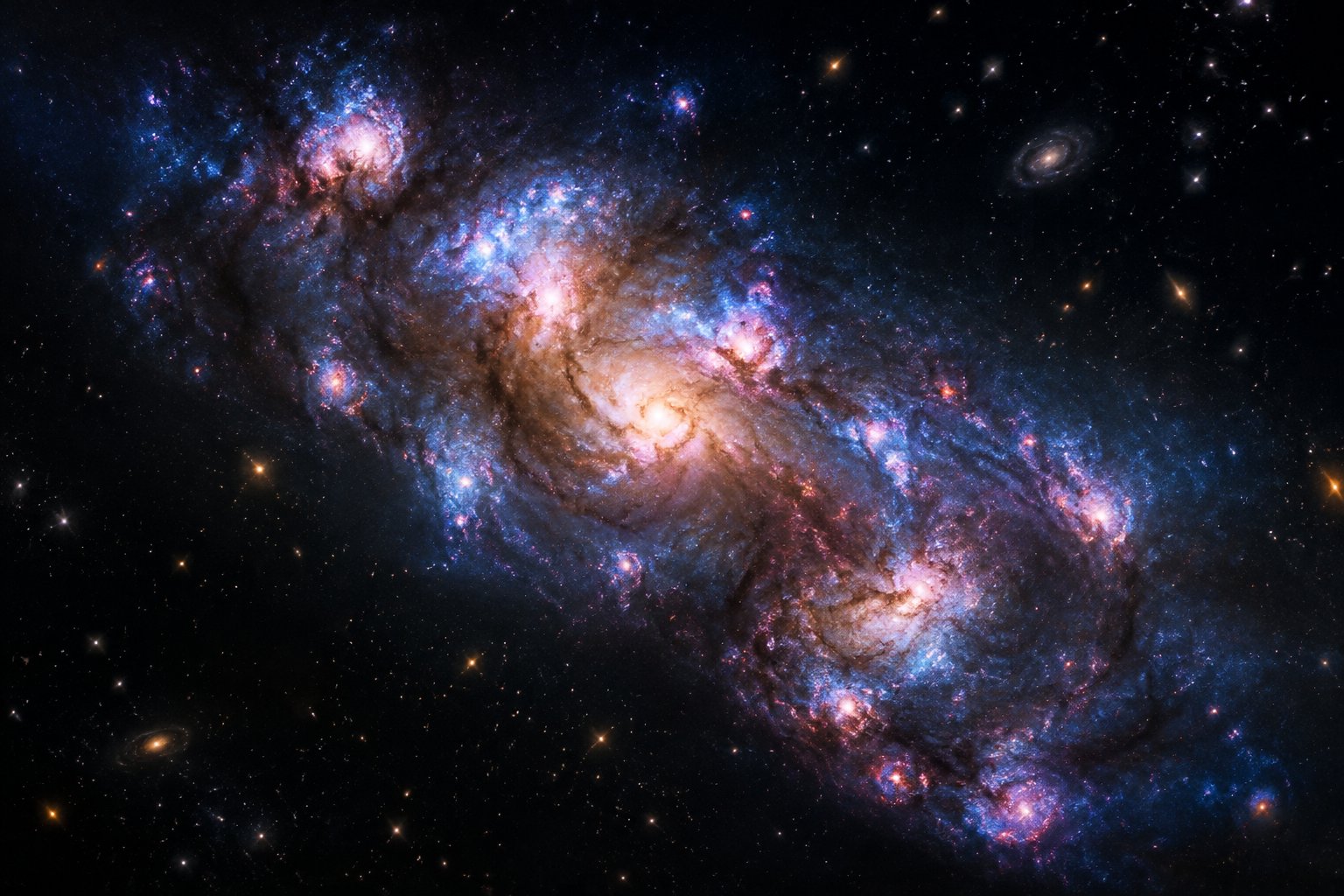
On Oct. 19, 2026, a study in The Astrophysical Journal reported that astronomers using the James Webb Space Telescope (JWST) had resolved compact star-forming clumps in Misty Moons, a galaxy observed at an estimated redshift of about 11–12. According to Phys.org, the galaxy’s light comes from a time roughly 370 million to 410 million years after the Big Bang. A foreground galaxy cluster magnified its light, making details visible that would otherwise be beyond the telescope’s resolving power.
What the observations revealed
The research team, led by Minami Nakane of the University of Tokyo, studied JWST Near-Infrared Camera (NIRCam) images of the galaxy-cluster field MACS J0257.1-2325. Phys.org reports that the observations used ten NIRCam filters and were supplemented by older Hubble Space Telescope images taken with three filters. The work appeared under the title “VENUS: A Strongly Lensed Clumpy Galaxy at z ∼ 11–12 Behind the Galaxy Cluster MACS J0257.1-2325.”
Gravitational lensing occurs when a massive object’s gravity bends light from something farther away. Here, the foreground cluster acted as a natural magnifier. The team’s two independent lens models indicated that the galaxy appeared in multiple images. According to Phys.org, two bright images, designated ID1 and ID2, were magnified roughly 20 to 30 times; a third possible image was identified, while two predicted images were too faint to detect.
The lensed views are distorted, so researchers modelled the cluster’s effect to reconstruct the galaxy’s structure. After processing the images to make small bright features easier to distinguish, the team identified four clumps in ID1 and three in ID2. PressTemps reports that the two reconstructed views share the same underlying structure. Each clump spans tens of parsecs and contains an estimated 10 million solar masses of young stars, around 40 million to 70 million years old. The clumps appear relatively poor in dust.
Together, the clumps account for at least 80% of Misty Moons’ estimated stellar mass, according to Phys.org and PressTemps. Researchers also estimate that the galaxy’s star-formation rate per unit area—its star formation surface density—is 100 to 10,000 times higher than in nearby dwarf galaxies.
What the result suggests—and what remains uncertain
The observations suggest that much of the galaxy’s young stellar population is concentrated in a handful of compact regions rather than spread smoothly across it. That is evidence about the structure of this particular early galaxy; it does not establish that every galaxy in the young universe formed in the same way. The team’s interpretation, as reported by Phys.org, is that galaxies at higher redshifts may tend to be clumpier, consistent with observations of other clumpy galaxies at z > 6.
Phys.org also reports the researchers’ view that early clumpy galaxies may differ from nearby dwarf galaxies in both their high star formation surface densities and their short, bursty periods of star formation. The comparison matters because a high overall star-formation rate alone does not necessarily explain why so much of Misty Moons’ stellar mass appears concentrated in clumps: the article notes that some massive galaxies nearby have high star formation rates but fewer stars in clusters.
There is an important caveat. The central clumps are bright and compact, and the team cannot rule out light from an actively feeding supermassive black hole. If such accretion contributes to the light, some of what is attributed to young stars may instead come from matter falling toward the black hole. The current imaging does not settle that question. Phys.org and Orbital Wire report that spectroscopy—splitting light into its component wavelengths to study its sources—could help distinguish stellar light from emission associated with an active galactic nucleus.
For readers following early-universe observations, the finding shows how a natural lens can extend JWST’s view: it can help astronomers examine structures that direct imaging cannot separate. It also adds an observed case to questions about how the first galaxies assembled, rather than resolving those questions. The possible relationship between dense young clusters and black-hole seeds is a separate research question explored in research on young clusters and black-hole seeds; the Misty Moons observations do not confirm a black hole in this galaxy.
Date and context
The study was published in The Astrophysical Journal on Oct. 19, 2026, according to Orbital Wire and Phys.org. Its estimated redshift of about 11–12 places Misty Moons in a period when the universe was roughly 370 million to 410 million years old. Redshift is the measurement used in the study to describe the galaxy’s position in cosmic history; here, the reported range corresponds to that early time.
Finding individual clusters in such distant galaxies is difficult because they are faint and small. Phys.org explains that astronomers use cluster formation efficiency to describe the fraction of newly formed stars that become members of bound star clusters. Previous research has linked this efficiency with star-formation rate, but examining individual clusters in galaxies this distant remains challenging. In Misty Moons, lensing offered a way to inspect compact features that would otherwise appear unresolved.
The clumps resemble young massive clusters and nuclear star clusters found nearby, Phys.org reports, and the researchers say they may be proto-globular clusters. That is a possibility, not a confirmed account of what these structures will become. The same caution applies to whether Misty Moons represents a broader pattern: PressTemps notes that the galaxy resembles other ultra-distant, faint systems, but more resolved examples are needed to test how common this kind of clustered star formation was.
What to watch next
The researchers’ next tests, as described by PressTemps, include finding and resolving more strongly lensed early galaxies. A larger set of examples could help show whether Misty Moons’ clumpy structure is representative or an unusual case made accessible by a particularly useful alignment. Further spectroscopy could also help determine how much of the central clumps’ light comes from stars and how much, if any, comes from black-hole accretion.
For now, the strongest result is observational: lensing allowed the team to identify compact clumps in a galaxy from the universe’s first half-billion years, and those clumps contain most of its estimated stellar mass. The broader story of how early galaxies formed—and the possible contribution of a black hole in Misty Moons—remains open.
Source: phys.org
More sources (3)
More from the Observatory
 Black holes
A gap in black-hole masses hints at stars that vanished without exploding
A Caltech-led analysis of 257 black-hole mergers found a shortage of objects between 12 and 16 solar masses. The pattern is consistent with a proposed failed-supernova channel, but it is not a direct observation of one.
Maya Ellison · Nov 19, 2026 · 4 min read
 Stars and galaxies
A Possible Atmosphere on TOI-431b, Seen in a Partial Eclipse
A JWST observation of the ultrahot rocky planet TOI-431b points to a possible atmosphere, but one partial eclipse cannot reveal its composition.
Maya Ellison · Nov 18, 2026 · 4 min read
 Deep space and cosmology
SN Ares: JWST finds a supernova whose next images may take decades
JWST observations reveal the lensed Type IIb supernova SN Ares. Models predict two more images decades from now, but those arrivals—and their timing—remain to be observed.
Maya Ellison · Nov 17, 2026 · 4 min read