
A Cosmic Push: Radiation Pressure May Help Explain Bright Early Galaxies
A study published on November 4 suggests that Lyman-alpha radiation can drive gas and dust out of low-density regions in early galaxies, clearing some starlight’s path to us. The result offers a possible contribution to their observed brightness, not a complete explanation.

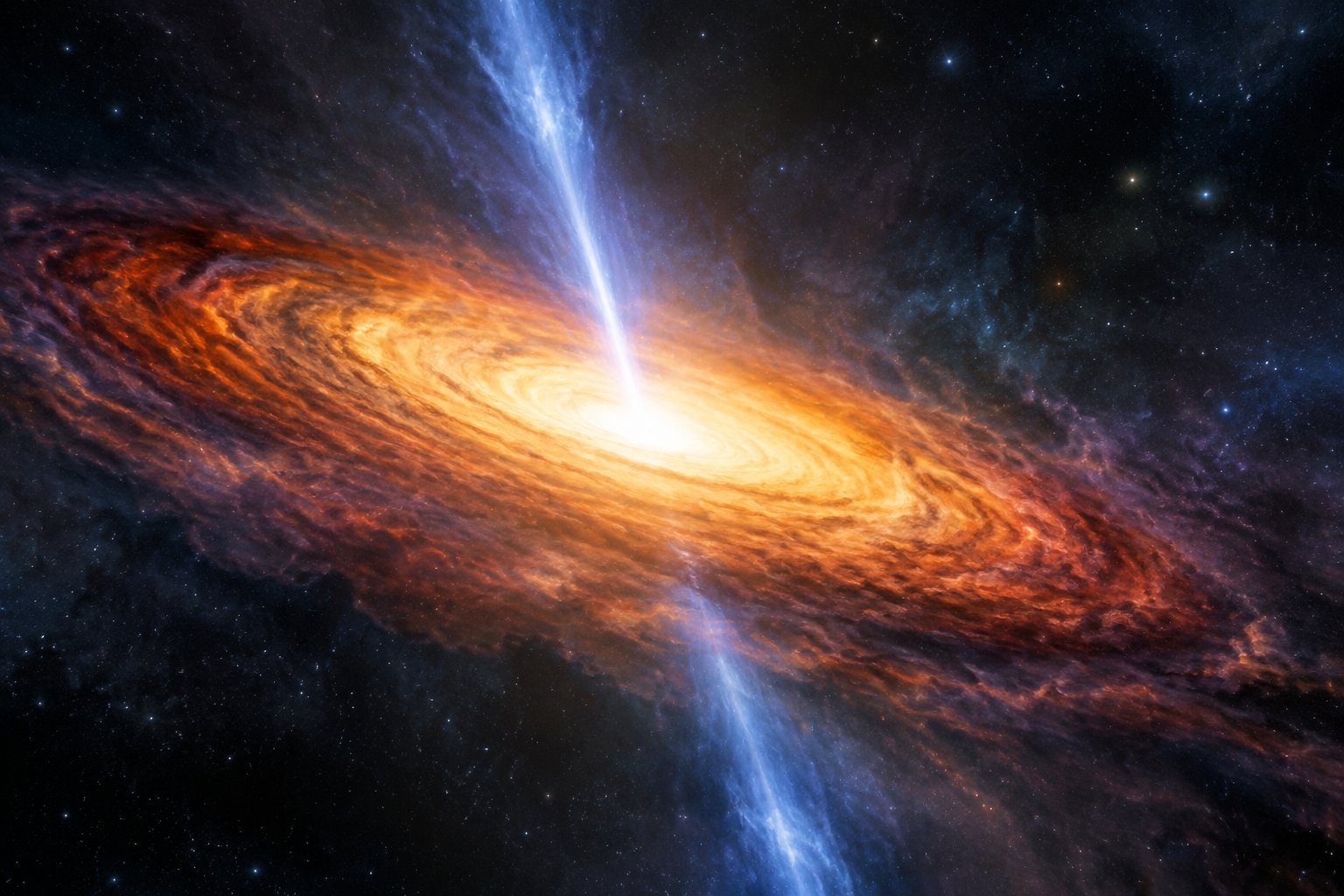
A study published in The Astrophysical Journal on November 4, 2026, suggests that light from young stars could help clear gas and dust from early galaxies. Researchers Shyam Menon of the Flatiron Institute and Aaron Smith of the University of Texas at Dallas estimated that Lyman-alpha radiation can push material out of low-density regions, potentially letting more starlight reach us. The work offers one possible contribution to the unexpectedly bright galaxies seen in the early universe; it does not settle why they appear so bright.
What the researchers found
According to the Simons Foundation’s report, Menon and Smith examined snapshots from an existing simulation of a star-forming region in the early universe. Rather than directly simulating the repeated interactions between Lyman-alpha light and matter, they used those snapshots to estimate the force the radiation would exert on gas and dust.
The estimate points to a difference between dense and diffuse environments. In dense regions, gravity kept the material bound to the stellar nursery despite the outward push. In the lower-density spaces between stars, where gravity was weaker, the radiation could overcome it and accelerate gas to high speeds. The Simons Foundation and Phys.org report that Menon described the resulting winds as capable of carrying material clear out of a galaxy.
When the density is low enough, the Lyman-alpha radiation can push the gas to really high speeds, launching explosive winds that can shoot material clear out of the galaxy.
Why the result matters for Webb’s bright galaxies
As Orbital Wire reported, observations from the James Webb Space Telescope have revealed more bright galaxies in the early universe than earlier models predicted. These galaxies appear in the universe’s first few hundred million years, raising questions about how quickly early galaxies formed and grew.
The proposed mechanism concerns how much of a galaxy’s existing starlight gets through, not whether its stars become intrinsically brighter. If radiation pressure sweeps loose gas and dust out of the spaces between stars, the view from Earth may be less obscured. That could help explain why some early galaxies look bright, while leaving open questions about how the galaxies formed and how much light their stars produced.
The finding is one possible piece of a broader early-universe puzzle. Other JWST-era coverage has considered young clusters as possible black-hole seed sites, a separate proposed pathway concerning the early universe.
How Lyman-alpha light can push matter
Lyman-alpha is ultraviolet radiation produced when an electron collides with a hydrogen atom or joins a hydrogen ion, according to the Simons Foundation. When gas or dust absorbs the light, the material recoils from the transfer of energy and momentum. That outward push is radiation pressure.
What makes Lyman-alpha especially challenging to model is how hydrogen handles it. Hydrogen atoms that absorb this radiation almost immediately re-emit it at the same wavelength. Nearby hydrogen can absorb and re-emit it again, so the light may interact repeatedly before escaping. Those repeated interactions can increase the force transferred to surrounding matter, but they also make a direct simulation computationally difficult.
The researchers’ approach estimated that force using existing simulation snapshots. It therefore tests what the radiation pressure could do in the modeled environment; it is not a direct observation of winds clearing gas from a particular early galaxy.
What remains uncertain—and what comes next
The study does not show that Lyman-alpha pressure is the sole reason early galaxies appear bright, or that it strongly suppresses star formation everywhere. In the dense regions examined, the gas and dust remained gravitationally bound. The estimated effect was strongest in thinner material between stars.
Menon said further work is needed to understand dust in the early universe. The Simons Foundation reports that a fuller picture will require simulations that treat Lyman-alpha radiation, gas flows and star formation together rather than estimating the radiation’s force from snapshots. Menon also noted that Olof Nebrin of Stockholm University and Smith have demonstrated that these effects can be modeled in two dimensions; the researchers hope improved computing power and algorithms will make three-dimensional simulations possible in coming years.
ICWWM’s report likewise frames the effect as a partial explanation and highlights the need to understand how early-universe dust affects Lyman-alpha photons. For readers tracking Webb’s early-galaxy discoveries, the useful distinction is between observed brightness and this proposed explanation for how much starlight escapes. Future integrated simulations may help test how important the effect is alongside other processes.
Source: simonsfoundation.org
More sources (3)
More from the Observatory
 Black holes
A gap in black-hole masses hints at stars that vanished without exploding
A Caltech-led analysis of 257 black-hole mergers found a shortage of objects between 12 and 16 solar masses. The pattern is consistent with a proposed failed-supernova channel, but it is not a direct observation of one.
Maya Ellison · Nov 19, 2026 · 4 min read
 Stars and galaxies
A Possible Atmosphere on TOI-431b, Seen in a Partial Eclipse
A JWST observation of the ultrahot rocky planet TOI-431b points to a possible atmosphere, but one partial eclipse cannot reveal its composition.
Maya Ellison · Nov 18, 2026 · 4 min read
 Deep space and cosmology
SN Ares: JWST finds a supernova whose next images may take decades
JWST observations reveal the lensed Type IIb supernova SN Ares. Models predict two more images decades from now, but those arrivals—and their timing—remain to be observed.
Maya Ellison · Nov 17, 2026 · 4 min read