
Leviathan’s wide stellar disk complicates the early-galaxy story
A JWST study finds that the massive, star-forming galaxy Leviathan has an extended distribution of stars, challenging the idea that every dusty early galaxy built a dense central core.

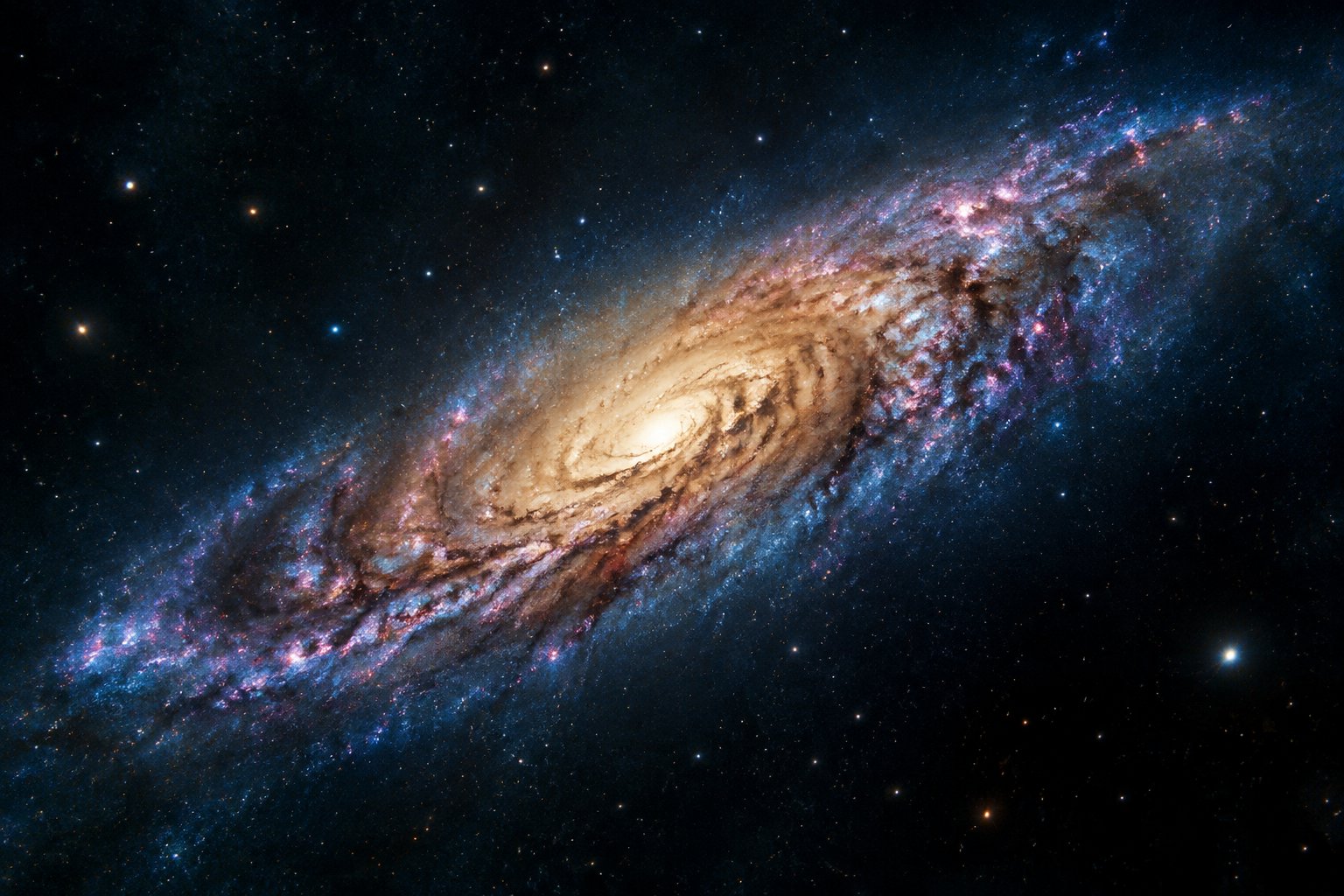
A study posted to arXiv on October 19 reports that Leviathan, a very massive galaxy in the early universe, is more extended than the compact, dense-core picture often proposed for galaxies of its kind. Using observations from the James Webb Space Telescope (JWST), William M. Baker and colleagues spectroscopically confirmed the submillimetre galaxy at a redshift of 4.05 and measured how its stars are spread across its disk. The evidence describes Leviathan as it was in the distant past; it does not establish what shape the galaxy eventually took.
What the observations show
The arXiv paper, titled Leviathan: a very massive, extended sub-millimetre galaxy spectroscopically confirmed at z = 4.05, reports a redshift of 4.051 based on JWST/NIRSpec observations. Redshift is the value used here to describe the galaxy’s place in the distant universe. Orbital Wire reports that the team measured it more precisely as z = 4.0514, using emission lines from hydrogen and ionized nitrogen in Leviathan’s spectrum.
To estimate the galaxy’s stellar mass, the researchers modelled its light across 31 wavelength bands, spanning from the rest-frame ultraviolet to the millimetre, according to the paper. They estimate a stellar mass of about 219 billion solar masses. The paper gives a star-formation rate of approximately 400 solar masses per year; Orbital Wire reports the estimate as about 410. These are estimates from the study, not a direct count of individual stars.
The team measured two different kinds of size. The half-light radius is the radius containing half the measured light at a particular wavelength; the paper reports 4.3 kiloparsecs in rest-frame 0.9-micrometre light. The half-mass radius describes where half the estimated stellar mass lies, and the study puts it at 3.1 kiloparsecs, with an uncertainty of 0.4 kiloparsecs. Kozmos explains that 3.1 kiloparsecs is about 10,000 light-years. Neither measurement marks the galaxy’s outer edge.
That distinction matters because brightness alone does not show where all the mass is. Dust can obscure stars, and younger stars can outshine older ones. Kozmos reports that the researchers analysed the galaxy’s stellar distribution separately and checked it with longer-wavelength infrared observations, where dust obscures stars less. The paper’s measurements indicate that Leviathan’s stars and dust are both extended, rather than the stars being concentrated in a small central core.
Why its structure matters
Submillimetre galaxies are dusty systems whose dust absorbs shorter-wavelength optical and ultraviolet light and emits energy at submillimetre wavelengths. Orbital Wire describes these galaxies as intense sites of star formation and notes that astronomers have considered them possible ancestors of massive quiescent galaxies: systems that have stopped forming stars. In that proposed path, the active dusty galaxies would need to build dense stellar cores quickly before becoming compact quiescent objects.
Leviathan complicates that picture. The arXiv paper reports that its half-mass radius is about three times larger than that of quiescent galaxies of the same mass. The study also compares it with GN20.2b, a galaxy with a similar mass and star-formation rate that is about three times smaller. Together, the comparison indicates that massive dusty galaxies at redshift around 4 can have notably different stellar structures.
The researchers tested a conditional scenario: if the available gas were converted into stars where the dust is now located, the half-mass radius would shrink to about 2.8 kiloparsecs, according to Orbital Wire and Kozmos. That would still leave Leviathan more extended than the compact systems in the proposed evolutionary picture. The paper also notes that Leviathan’s measured mass is consistent with the standard cosmological model for a star-formation efficiency of approximately 20%; its unusual feature here is the distribution of its stars, not a reported conflict with that model.
Background: a galaxy seen in the young universe
Leviathan was first identified as a massive submillimetre galaxy in 2012, according to Orbital Wire. The new study uses JWST observations to examine the faint stellar light as well as the dust emission. That lets the researchers estimate where stellar mass is located, rather than treating the dust’s glow—which traces current star formation—as a map of all the stars.
Orbital Wire places the galaxy in a period about 11.5 billion years ago. For context, the same report describes massive quiescent galaxies from roughly 11.5 to 12.5 billion years ago as compact, with half-light radii of 0.2 to 1 kiloparsec. The question is whether active dusty galaxies like Leviathan generally developed into such compact systems, or whether some followed other paths.
The study’s title calls Leviathan a “sub-millimetre galaxy,” referring to the wavelength range associated with its dust emission, not a direct image of the galaxy’s full structure. Its stellar sizes come from modelling and analysis of telescope observations. The paper was posted to arXiv in 2026 and is described there as a four-page paper submitted as an Astronomy & Astrophysics letter.
What remains open
The observations do not settle Leviathan’s eventual fate. Orbital Wire reports that, if its current star formation continues with the same spatial distribution, the galaxy is unlikely to become a compact massive quiescent galaxy in the way researchers have proposed for some systems. Kozmos describes an extended disk that later stops forming stars as one possible outcome. A different structure could require a substantial flow of mass toward the centre or a change such as a merger, but these are possibilities discussed in the report, not observed events in Leviathan’s future.
For readers following JWST’s early-universe results, the key point is that a galaxy’s total estimated mass does not tell the whole story. Measuring where the stellar mass lies can test assumptions about how galaxies assemble their cores. The study adds evidence that very massive dusty galaxies do not all share the same internal structure; it does not show that every such galaxy avoids becoming compact.
The next question is whether observations of more early galaxies will reveal how common Leviathan’s extended structure is and what processes shape their later evolution. The sources report no specific date for a follow-up decision or observation. For now, the study’s measured sizes and the contrast with GN20.2b make the diversity of early massive galaxies the result to keep in view.
Source: arxiv.org
More sources (2)
More from the Observatory
 Black holes
A gap in black-hole masses hints at stars that vanished without exploding
A Caltech-led analysis of 257 black-hole mergers found a shortage of objects between 12 and 16 solar masses. The pattern is consistent with a proposed failed-supernova channel, but it is not a direct observation of one.
Maya Ellison · Nov 19, 2026 · 4 min read
 Stars and galaxies
A Possible Atmosphere on TOI-431b, Seen in a Partial Eclipse
A JWST observation of the ultrahot rocky planet TOI-431b points to a possible atmosphere, but one partial eclipse cannot reveal its composition.
Maya Ellison · Nov 18, 2026 · 4 min read
 Deep space and cosmology
SN Ares: JWST finds a supernova whose next images may take decades
JWST observations reveal the lensed Type IIb supernova SN Ares. Models predict two more images decades from now, but those arrivals—and their timing—remain to be observed.
Maya Ellison · Nov 17, 2026 · 4 min read