
Could a Primordial Black Hole Explain JWST’s QSO1? A Model Tests the Idea
A Johns Hopkins-led study models whether a primordial black hole could grow into QSO1, a young, metal-poor object observed by JWST. The result explores a possibility; it does not detect a primordial black hole.

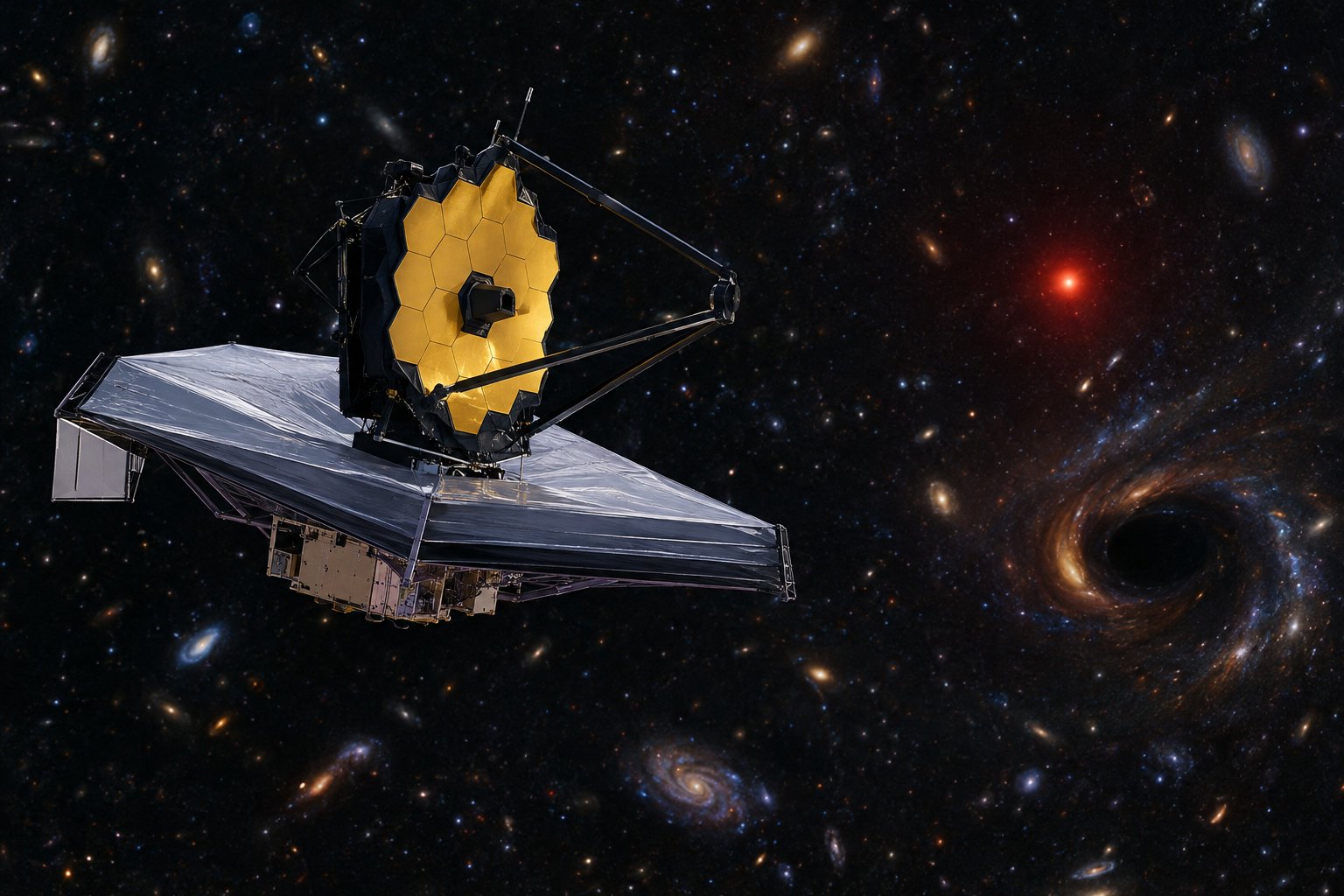
A Johns Hopkins-led team used James Webb Space Telescope data to model whether the little red dot QSO1 could have grown around a primordial black hole. The study, published in Physical Review Letters in 2026, examines a possible explanation for an object seen when the universe was about 700 million years old. As Phys.org reported on November 5, the researchers’ models make a primordial origin possible under certain conditions—but do not report detecting one.
What the researchers modeled
The team treated QSO1 as a test case. Researchers had suspected it might be compatible with a primordial black hole because of its age, size and composition. Unlike other little red dots, QSO1 is described as being made almost entirely of hydrogen and helium—the first elements to form—and lacking the heavier elements that appeared later in the universe’s history.
According to Phys.org, the researchers modeled three scenarios to ask whether a primordial black hole could develop into an object the size of QSO1 and acquire a surrounding disk. The scenario they considered most likely starts with a smaller primordial black hole pulling in surrounding gas and energy, then growing. The researchers say this route can account for QSO1 while meeting cosmological constraints.
That is a result about what a model allows, not an observation of how QSO1 formed. JWST data supplied the observed object for the comparison; the proposed primordial origin remains an interpretation.
Why QSO1 is an unusual test
A primordial black hole is a theoretical black hole that would have formed in the early universe, before stars. That differs from the familiar picture of a black hole born through the gravitational collapse of a star. Phys.org quoted co-author Valerio De Luca of Johns Hopkins explaining that primordial black holes would arise through different early-universe physics.
Little red dots are compact, reddish objects seen in JWST images. The Phys.org report describes them as swirling, superhot disks of gas, energy and galactic dust particles. Such objects could surround ordinary astrophysical black holes; the report says some might instead be associated with primordial black holes, if those objects exist. Their appearance alone does not establish which kind of black hole, if any, is involved.
QSO1’s early age and simple elemental composition make it a useful case for testing a possible primordial pathway. The model matters because it asks whether that idea can fit a particular observed object while respecting limits on how many primordial black holes could exist. It does not show that QSO1 is one.
The door was open on this theory, that little red dots could be primordial black holes. We've now cracked it open a little further by showing some scenarios are more likely than others.
What the result does—and does not—show
The study adds a modeled route by which an early black hole might grow into something like QSO1. It does not provide direct evidence that primordial black holes exist, nor does it establish that QSO1 contains one. Phys.org reports that astrophysicists have not found direct evidence for primordial black holes.
The distinction is important: a scenario that fits an observed object is not the same as identifying the object’s origin. The researchers say a definitive case would require finding a black hole too light to be an astrophysical black hole, or one so old that it predates stars. Until evidence of that kind is found, primordial black holes remain a theoretical possibility.
For readers following JWST’s view of the early universe, the value of the work is in narrowing the question. The models suggest that at least one possible growth path deserves further examination; they do not turn a candidate explanation into a discovery.
What researchers plan to examine next
The researchers plan to investigate how many of the 100 observed and cataloged little red dots could possibly be primordial black holes. That next step would extend the question beyond QSO1, but the report does not give a date for the work or say what its outcome will be.
The broader issue also remains open: researchers do not have a clear understanding of what happened in the early universe immediately after the Big Bang. If primordial black holes exist, their formation would require an explanation. For now, QSO1 is a modeled possibility to test against future evidence—not confirmation of a new class of black holes.
Source: phys.org
More from the Observatory
 Black holes
A gap in black-hole masses hints at stars that vanished without exploding
A Caltech-led analysis of 257 black-hole mergers found a shortage of objects between 12 and 16 solar masses. The pattern is consistent with a proposed failed-supernova channel, but it is not a direct observation of one.
Maya Ellison · Nov 19, 2026 · 4 min read
 Stars and galaxies
A Possible Atmosphere on TOI-431b, Seen in a Partial Eclipse
A JWST observation of the ultrahot rocky planet TOI-431b points to a possible atmosphere, but one partial eclipse cannot reveal its composition.
Maya Ellison · Nov 18, 2026 · 4 min read
 Deep space and cosmology
SN Ares: JWST finds a supernova whose next images may take decades
JWST observations reveal the lensed Type IIb supernova SN Ares. Models predict two more images decades from now, but those arrivals—and their timing—remain to be observed.
Maya Ellison · Nov 17, 2026 · 4 min read