
A grainy cosmic signal puts limits on giant black holes as dark matter
A 2026 study led by Christopher Gerlach finds that stupendously large black holes could not make up a significant share of dark matter without leaving a cosmic microwave background signal that Planck measurements do not show.

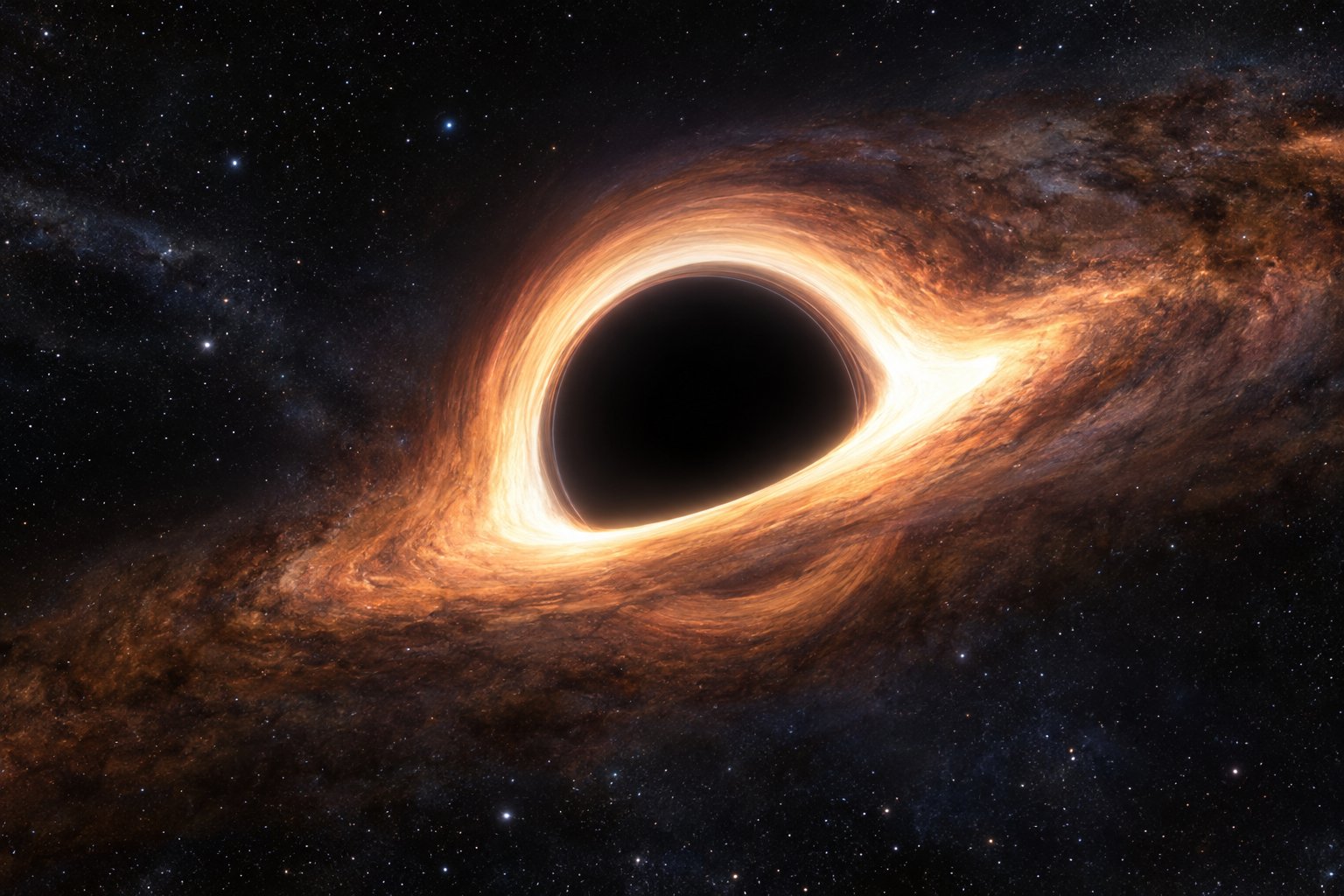
Research published in Physical Review Letters in 2026 concludes that stupendously large black holes could not make up a significant component of dark matter. In a report dated November 14, 2026, Orbital Wire said the study was led by Christopher Gerlach of Johannes Gutenberg University in Mainz, Germany. The researchers compared the cosmic microwave background—the afterglow of the Big Bang—with the signal these hypothetical black holes should have produced.
What the researchers found
Orbital Wire reported that the team modeled how stupendously large black holes, or SLABs, would affect the cosmic microwave background (CMB), then compared the predicted pattern with Planck satellite measurements. If SLABs existed in large numbers and made up a significant share of dark matter, they should leave a characteristic grainy imprint in the CMB. The observed background does not show that imprint.
The proposed signal comes from isocurvature perturbations: differences in the density of the early Universe from place to place. According to Orbital Wire, the perturbations expected from a significant SLAB population would exceed the limits set by Planck measurements. The study’s conclusion rests on this mismatch between the predicted signal and the observed CMB.
SLABs are hypothetical primordial black holes—objects proposed to have formed in the early Universe—with masses reaching up to 10 billion billion times the Sun’s mass. Unlike black holes formed when massive stars collapse, primordial black holes are proposed to have formed from early concentrations of matter. Their existence has not been established by this analysis.
Why this result matters
Dark matter is thought to account for around 85 percent of the matter in the Universe, but its physical nature remains unknown, Orbital Wire reported. The result narrows one proposed explanation: SLABs cannot be a significant part of dark matter under the assumptions tested. It does not identify what dark matter is, or show that every kind of primordial black hole is absent.
The finding also bears on other questions involving the early Universe. Orbital Wire reported that it challenges scenarios in which primordial-black-hole-induced fluctuations helped explain massive early galaxy candidates observed by the James Webb Space Telescope (JWST). Other proposed explanations for possible black-hole seeds in early galaxies remain a separate line of inquiry, including JWST clusters as possible black-hole seed sites.
SLABs had also been considered as a possible explanation for the gravitational-wave background hum reported by pulsar timing arrays, which monitor pulsars for gravitational waves. Orbital Wire said the new result makes that explanation unlikely because the black holes would not have existed in large numbers. That is a constraint on this proposed source, not a finding that settles the origin of the background.
The CMB and the study’s context
The CMB is relic radiation released when the Universe was about 380,000 years old. It is the oldest detectable light and is mostly smooth, with small fluctuations that measurements can examine. In this study, those fluctuations serve as a record against which researchers tested the expected effects of SLABs.
Orbital Wire reported that the analysis relied heavily on data from the European Space Agency’s Planck satellite, whose mission ended in 2013. The satellite’s observations continue to be used in research, including through more computing power, comparisons with newer data sets and improved filtering of interference.
Earlier studies had nearly ruled out ordinary primordial black holes as the entirety of dark matter. The new result concerns the proposed stupendously large mass range and adds a constraint based on the CMB. It does not rule out SLABs altogether: the team assumed all black holes in the population had the same mass. Populations spanning a wide range of masses still need to be explored.
What to watch next
Future CMB observations may tighten the limits. Orbital Wire reported that researchers expect experiments including LiteBIRD and the Simons Observatory to improve constraints on the predicted signal. The key question is whether those observations, alongside further study of populations with a range of black-hole masses, change how much room remains for primordial black holes in dark matter models.
For now, the measured CMB does not contain the grainy imprint expected if SLABs made up a significant share of dark matter. The result narrows that possibility; the broader search for dark matter candidates continues.
Source: orbital-wire.com
More from the Observatory
 Black holes
A gap in black-hole masses hints at stars that vanished without exploding
A Caltech-led analysis of 257 black-hole mergers found a shortage of objects between 12 and 16 solar masses. The pattern is consistent with a proposed failed-supernova channel, but it is not a direct observation of one.
Maya Ellison · Nov 19, 2026 · 4 min read
 Stars and galaxies
A Possible Atmosphere on TOI-431b, Seen in a Partial Eclipse
A JWST observation of the ultrahot rocky planet TOI-431b points to a possible atmosphere, but one partial eclipse cannot reveal its composition.
Maya Ellison · Nov 18, 2026 · 4 min read
 Deep space and cosmology
SN Ares: JWST finds a supernova whose next images may take decades
JWST observations reveal the lensed Type IIb supernova SN Ares. Models predict two more images decades from now, but those arrivals—and their timing—remain to be observed.
Maya Ellison · Nov 17, 2026 · 4 min read