
Light-Made Mirrors Recreate a Black-Hole Horizon Analogy
Researchers used ultracold lithium atoms and moving barriers of light to reproduce wave dynamics associated with black- and white-hole horizons—not to create a gravitational black hole.

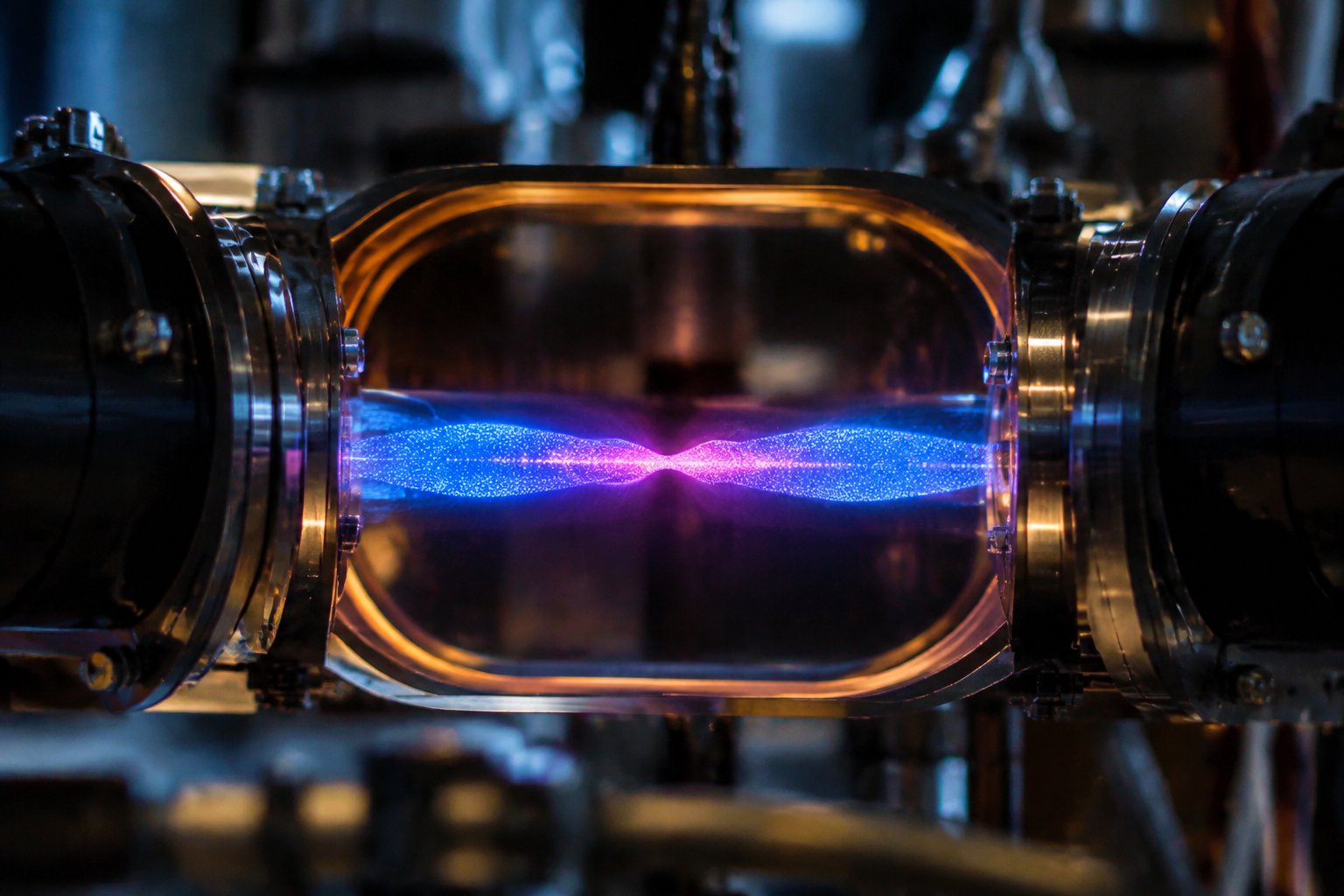
Physicists have used ultracold lithium atoms confined between barriers made of light to reproduce wave dynamics associated with black- and white-hole horizons. The laboratory experiment was reported in Physical Review Letters on November 4, 2026; it created an analogue of selected horizon behaviour, not a gravitational black hole. The study is by Jeremy L. Tanlimco and colleagues, and Phys.org describes the researchers as Weld’s team.
How the experiment produced horizon-like motion
The researchers exchanged the usual roles of a cavity and its contents. In a familiar optical setup, mirrors confine light while the mirrors themselves remain the boundaries. Here, according to Phys.org’s report, ultracold lithium atoms formed the wave, while two sheets of laser light acted as mirrors. One light sheet moved back and forth around 100 times per second.
At ultracold temperatures, atoms behave as waves. The team cooled lithium gas close to absolute zero and held it in a grid of laser light, which guided the matter waves at nearly constant speeds of less than one metre per second. The moving barrier changed the conditions experienced by the wave as it travelled between the light-made boundaries.
The researchers imaged the distribution of atoms over time and compared it with theoretical predictions. The initially diffuse cloud formed a concentrated packet following a repeating path within a few cycles. Phys.org reports that trajectories beginning at different positions moved away from an unstable path and converged on a stable one. The researchers associate that pattern with one-way motion analogous to the behaviour of black- and white-hole horizons.
Driving the moving barrier at twice the relevant frequency produced two concentrated packets, according to both Phys.org and QubitWire. QubitWire reports that the effect was examined near the cavity’s fundamental resonance—the lowest resonant frequency in the setup—and that changing the drive’s phase could exchange the stability of the paths. Phys.org describes an abrupt shift in the barrier’s timing as reversing the packets’ motion.
Why this result matters
A black-hole horizon is not something researchers can adjust in a laboratory. An analogue experiment instead lets them investigate specific relationships in a system they can manipulate and observe repeatedly. The value of this result is in testing selected wave behaviour under controlled conditions—not in reproducing every feature of a real black hole.
For readers following black-hole research, that distinction keeps the finding in scale. The observed packets and paths are evidence about the dynamics of ultracold matter waves in this apparatus. Their connection to black- and white-hole horizons is an analogy described through the system’s theoretical relationship to curved spacetime, not a direct measurement of a cosmic horizon.
The work also illustrates how researchers can study wave behaviour by changing the boundary conditions around a wave. Rather than trying to move a material mirror at a substantial fraction of light speed, the team used slower matter waves and barriers made from light. The experiment’s central contribution is this change of approach.
Background and publication context
In a cavity, a wave travels repeatedly between boundaries. Moving a boundary can alter the conditions the wave encounters, changing how its energy and motion develop. QubitWire explains that doing this with light and a material mirror is experimentally difficult because light travels so fast. Using atoms provides a slower wave and gives the moving boundary a better chance to influence it.
The paper appeared in Physical Review Letters on November 4, 2026. QubitWire reports that a preprint—the earlier public version of a research paper—was posted on January 28, making the journal publication the peer-reviewed publication rather than the first public disclosure of the work. The two reports describe a related detail of the analogy: Phys.org notes that the atoms’ speed was not quite as constant as light’s, producing subtle effects beyond the ideal light-like picture.
Stroboscopic imaging is another part of the interpretation. It means examining a repeating process at selected moments in its cycle, rather than following every instant continuously. QubitWire compares the idea to a spinning wheel that can appear to move strangely under a flashing light. In this experiment, snapshots helped reveal how trajectories converged or diverged over time.
What to watch next
Phys.org reports that the team hopes the effect may lead to ways of compressing and decompressing optical signals, potentially using solid materials whose optical properties can be tuned electrically rather than moving mirrors. The report also says the setup could help physicists explore other predictions, including the creation of pairs of light particles from empty space between rapidly moving mirrors. These are possible future directions, not results demonstrated by this experiment.
For now, the key point is precise: ultracold atoms between moving light barriers displayed controlled wave patterns that resemble selected horizon dynamics. Further claims about applications or other predictions will depend on what subsequent experiments establish.
Source: phys.org
More sources (1)
More from the Observatory
 Black holes
A gap in black-hole masses hints at stars that vanished without exploding
A Caltech-led analysis of 257 black-hole mergers found a shortage of objects between 12 and 16 solar masses. The pattern is consistent with a proposed failed-supernova channel, but it is not a direct observation of one.
Maya Ellison · Nov 19, 2026 · 4 min read
 Stars and galaxies
A Possible Atmosphere on TOI-431b, Seen in a Partial Eclipse
A JWST observation of the ultrahot rocky planet TOI-431b points to a possible atmosphere, but one partial eclipse cannot reveal its composition.
Maya Ellison · Nov 18, 2026 · 4 min read
 Deep space and cosmology
SN Ares: JWST finds a supernova whose next images may take decades
JWST observations reveal the lensed Type IIb supernova SN Ares. Models predict two more images decades from now, but those arrivals—and their timing—remain to be observed.
Maya Ellison · Nov 17, 2026 · 4 min read