
A magnetic hollow-core jet may explain GRB 221009A’s changing signal
A China–Italy team interprets evolving gamma-ray features from GRB 221009A as possible evidence for a magnetized jet with a hollow core. The geometry remains an inference, not a direct observation of the jet’s interior.

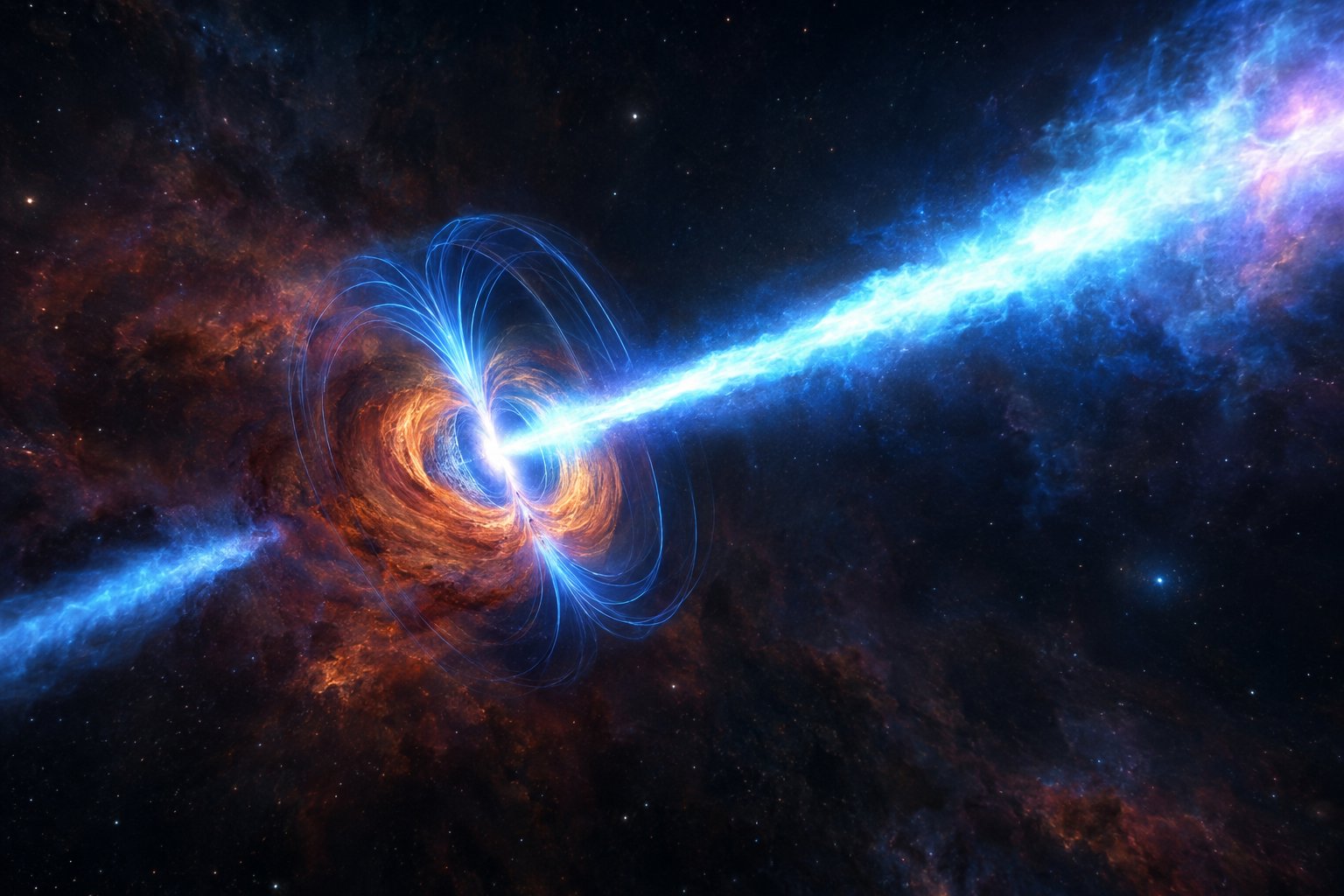
A China–Italy research team proposes that the unusually bright gamma-ray burst GRB 221009A may have launched a jet dominated by magnetic fields and containing a hollow core. The interpretation, reported by Orbital Wire on November 19, 2026, draws on changes in the burst’s gamma-ray spectrum; it is not a direct image or measurement of the jet’s interior. The study appeared in The Astrophysical Journal Letters on November 12, 2026.
What the team found
The team analyzed data from HEPP-H, a detector aboard the CSES-01 mission, also called Zhangheng-1. HEPP-H monitors energetic charged particles and detects gamma rays indirectly through secondary electrons. Because it did not saturate during the burst’s brightest phase, it retained data from an interval that conventional instruments could not fully measure at peak intensity.
To reconstruct the burst’s spectrum, the researchers applied a dynamic Monte Carlo correction and cross-calibrated the results against observations from GECAM-C and Fermi. Orbital Wire reports that this approach addressed data lost to detector saturation in other instruments.
The analysis identified a spectral bump near two mega-electronvolts, a unit of energy. The feature appeared in all six time intervals the team examined. The researchers say the standard Band function, commonly used to fit gamma-ray burst spectra, could not account for it on its own, so an additional component was needed. If the bump is interpreted as thermal emission, it represents about six percent of the gamma-ray energy in that interval. That conditional interpretation is consistent with a weak hot fireball alongside a stronger, likely magnetized jet; it does not establish that explanation as the only possibility.
Li Xinqiao of the Institute of High Energy Physics, the study’s corresponding author, said HEPP-H offered a view of the burst while it was exceptionally bright:
HEPP-H let us study the burst when it was exceptionally bright
A changing emission line—and a proposed geometry
A second part of the evidence is an emission line: a relatively narrow feature at a particular energy in the spectrum. Fermi first identified a line near 12 mega-electronvolts, possibly associated with electron–positron annihilation. CSES-01 had detected it earlier in the burst, when it was brighter, near 40 mega-electronvolts. The line’s energy then fell roughly in inverse proportion to time, while its width remained around ten percent of its central energy.
The feature reached statistical significance of about 4.0 sigma in one interval and more than 4.5 sigma in another. Statistical significance describes how strongly a result stands out from expected random variation; it does not by itself identify the physical cause. The researchers say their observations extend the documented evolution of the line roughly five seconds closer to the burst’s onset. Roberto Battiston of the University of Trento and the Trento Institute for Fundamental Physics and Applications said the agreement between CSES-01 and Fermi, despite their different designs, supports an evolving emission process.
To explain the line’s rise-and-fall behavior, the team proposes a structured jet with a ring-like magnetic field and a hollow central region. In this picture, weaker line emission near the jet’s axis comes first, followed by stronger emission from an off-axis region. That sequence could produce the observed change in the signal. But the hollow-core shape is an inference from how the spectral feature behaves—not an observed image, nor a direct measurement of the jet’s inner structure.
Why this matters for gamma-ray burst research
Gamma-ray bursts are among the most powerful events in the universe. Researchers connect long bursts with exceptionally bright supernovae and short bursts with neutron-star collisions. In the standard picture described by Orbital Wire, these events produce ultra-fast plasma jets: long bursts from a black hole left behind by the stellar explosion, and short bursts from neutron-star mergers.
How those jets form remains unresolved. A simple “top-hat” model treats the outflow as relatively uniform, while structured-jet models allow different regions to have different properties. Evidence that helps distinguish between these pictures can inform research into how a burst’s central engine powers its jets. The proposed magnetic hollow core adds one possible structure to consider, but does not settle the broader question of how the jets form. It also sits alongside research into possible warnings before black-hole jet ejections, a separate question about jet behavior.
Earlier observations and what comes next
Other observations of GRB 221009A have also informed the debate over jet structure. In 2022, the CTAO LST-1 telescope observed the burst beginning 1.33 days after the explosion and continuing over 20 days. The observations took place during commissioning at the Roque de los Muchachos Observatory on La Palma. A collaboration report published in The Astrophysical Journal Letters on July 23, 2025, described a hint of excess gamma-ray flux. The excess remained below the formal detection threshold, but the data constrained very-high-energy emission and helped distinguish between competing jet models.
The LST-1 team’s data supported a complex jet with a narrow, ultra-fast core and a wider, slower sheath, rather than a uniform outflow. Those observations and the newer spectral analysis examine different evidence: the former concerns very-high-energy emission, while the China–Italy team’s proposed hollow core is an interpretation of spectral features. Together, they underline why multiple instruments and energy ranges matter when studying a brief, changing event.
For now, the key result is the evidence for unusual spectral features and their evolution, alongside a proposed explanation for them. The magnetic hollow-core geometry remains a hypothesis to test against further observations and models. Orbital Wire also notes that particle-monitoring instruments such as HEPP-H can contribute to transient astrophysics when their data are combined and cross-calibrated with observations from dedicated gamma-ray observatories.
Source: orbital-wire.com
More from the Observatory
 Black holes
A gap in black-hole masses hints at stars that vanished without exploding
A Caltech-led analysis of 257 black-hole mergers found a shortage of objects between 12 and 16 solar masses. The pattern is consistent with a proposed failed-supernova channel, but it is not a direct observation of one.
Maya Ellison · Nov 19, 2026 · 4 min read
 Stars and galaxies
A Possible Atmosphere on TOI-431b, Seen in a Partial Eclipse
A JWST observation of the ultrahot rocky planet TOI-431b points to a possible atmosphere, but one partial eclipse cannot reveal its composition.
Maya Ellison · Nov 18, 2026 · 4 min read
 Deep space and cosmology
SN Ares: JWST finds a supernova whose next images may take decades
JWST observations reveal the lensed Type IIb supernova SN Ares. Models predict two more images decades from now, but those arrivals—and their timing—remain to be observed.
Maya Ellison · Nov 17, 2026 · 4 min read