
X-rays may offer a warning before black hole jets erupt
A study of four stellar-mass black hole systems found changes in X-rays one to 10 days before radio activity linked to jet ejections. The researchers propose that monitoring these changes could help observatories time their follow-up observations.

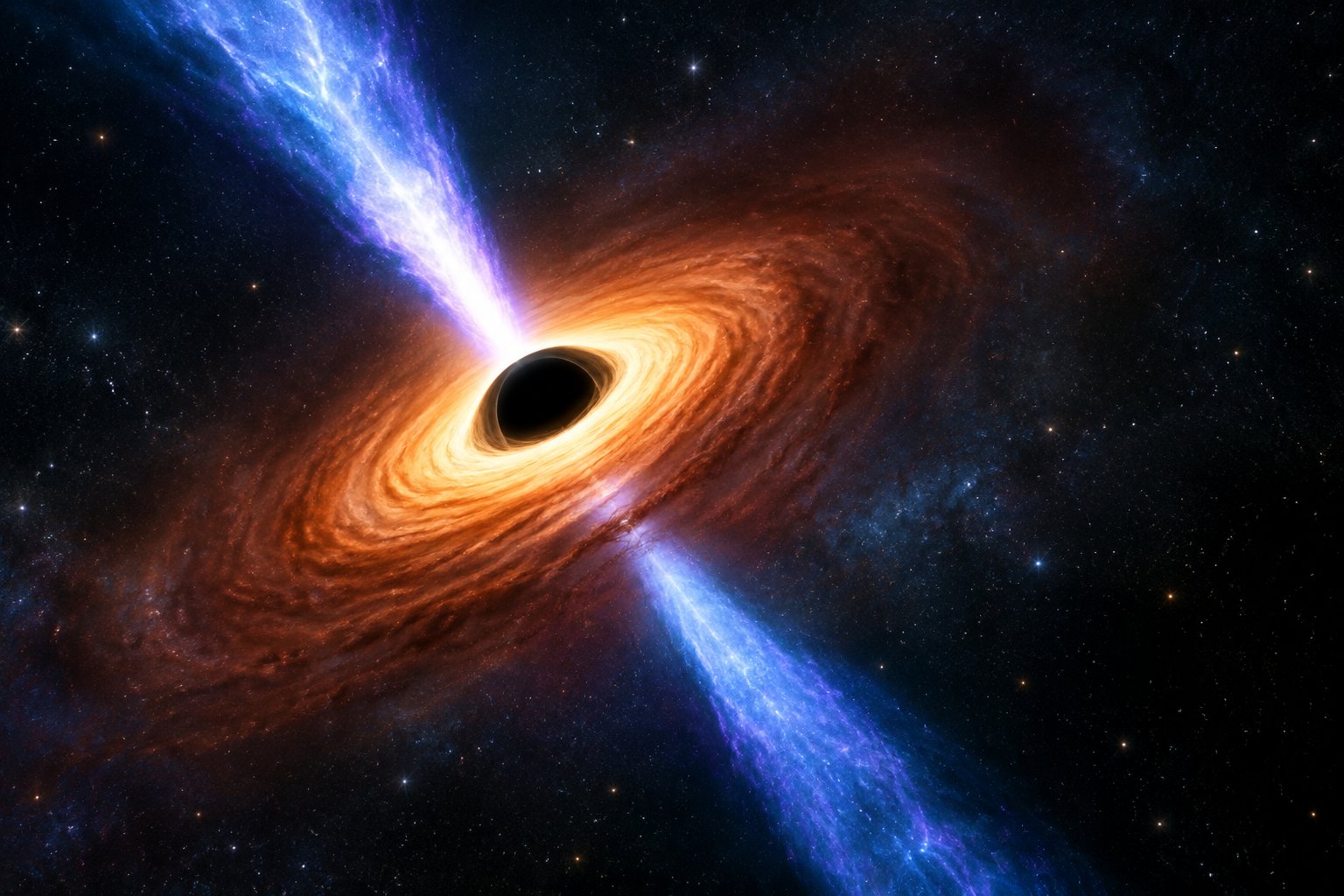
On November 12, 2026, Toshihiro Kawaguchi of the University of Toyama and Kazutaka Yamaoka of Nagoya University published a study in The Astrophysical Journal proposing that X-ray changes could help anticipate jet ejections from stellar-mass black holes. Across four black hole systems, the researchers found drops in the inner disk radius and X-ray variability one to 10 days before radio activity associated with the ejections, Orbital Wire reported.
What the researchers found
The paper, titled Jet Forecast: Timing of Discrete Jet Ejections of Stellar-mass Black Holes Anticipated via X-Ray Properties, compares X-ray properties with radio activity across four black hole X-ray binary systems. The central pattern was consistent across all four: the inner disk radius, written as Rin, and X-ray variability, written as rms, declined one to 10 days before radio activity from a jet ejection.
Rin refers to the measured inner radius of the disk around the black hole. The study uses rms to describe X-ray variability. The researchers present the synchronized declines as possible precursors—signals that may come before an event—not as proof that the changes themselves cause a jet to launch.
The team also looked for a rise in the amount of material being accreted, or drawn in, before ejections. Orbital Wire reported that they found no reliably detected increase and no large jumps in the accretion rate around the events. That absence does not establish a single alternative trigger, but it does not fit models that require a sudden surge of infalling material to launch a jet.
There was a qualified exception in the detail from one system. During the outburst of XTE J1859+226, the accretion rate declined exponentially, with a timescale of about 30 days. The data also hinted at an increase of roughly 20 percent just before jet production. The researchers said better data from future jet-forecast observations would be needed to confirm that tentative signal.
Monitoring of Rin seems to be suitable for predicting the timing of jet ejections,
Why the proposed forecast matters
Jet ejections are transient events, so a warning that narrows down when to observe could help facilities direct their instruments at the right time. Kawaguchi said that a forecast based on monitoring Rin could let observing facilities concentrate on expected ejection times and advance the study of jet physics.
The proposed approach would issue alerts when Rin and rms are continuously decreasing and Rin approaches the innermost stable circular orbit. That alert could prompt Target of Opportunity observations: observations scheduled in response to an event or anticipated event, directing other telescopes to follow it. The goal would be to gather more complete observations of the extreme physics around black holes.
For readers, the key distinction is between a promising pattern and a dependable forecast. The study reports a lead time in four systems and proposes a way to use the pattern; it does not establish that every future jet ejection can be predicted. Its practical value will depend on whether the signals hold up in further observations.
Background: from one outburst to four systems
The new study builds on work the researchers began in 2025, using observations of XTE J1859+226 during an outburst in 1999–2000. Orbital Wire reported that the earlier paper established the first case of the proposed relationship. The team added three systems in the new study, bringing its total to four, to test whether the disk–jet connection appeared beyond the original source.
Another result concerns the Eddington limit, the threshold at which inward gravity is balanced by outward radiation pressure. The researchers found jets forming below that limit in two of the four systems. This conflicts with models that say super-Eddington accretion—accretion above the Eddington limit—is necessary for a jet to launch. It adds to the evidence considered by researchers about the conditions associated with jet formation, without by itself resolving how jets are produced.
What to watch next
The next test identified in the report is better data from future jet-forecast observations, particularly to check whether the tentative accretion-rate increase in XTE J1859+226 is real. The proposed monitoring strategy also needs further observations to assess how well the declines in Rin and rms anticipate ejections across additional events. No specific future observing date is given in the report.
For now, the result is an observational clue and a proposed tool for coordinating telescope time—not a claim that black hole jets can already be forecast with certainty.
Source: orbital-wire.com
More from the Observatory
 Black holes
A gap in black-hole masses hints at stars that vanished without exploding
A Caltech-led analysis of 257 black-hole mergers found a shortage of objects between 12 and 16 solar masses. The pattern is consistent with a proposed failed-supernova channel, but it is not a direct observation of one.
Maya Ellison · Nov 19, 2026 · 4 min read
 Stars and galaxies
A Possible Atmosphere on TOI-431b, Seen in a Partial Eclipse
A JWST observation of the ultrahot rocky planet TOI-431b points to a possible atmosphere, but one partial eclipse cannot reveal its composition.
Maya Ellison · Nov 18, 2026 · 4 min read
 Deep space and cosmology
SN Ares: JWST finds a supernova whose next images may take decades
JWST observations reveal the lensed Type IIb supernova SN Ares. Models predict two more images decades from now, but those arrivals—and their timing—remain to be observed.
Maya Ellison · Nov 17, 2026 · 4 min read