
Two black-hole signals put detector calibration in focus
The LIGO-Virgo-KAGRA Collaboration announced two binary black-hole detections and an informative application of astrophysical calibration. The reported signal-to-noise ratios were 32 for GW240925 and 69 for GW250207.

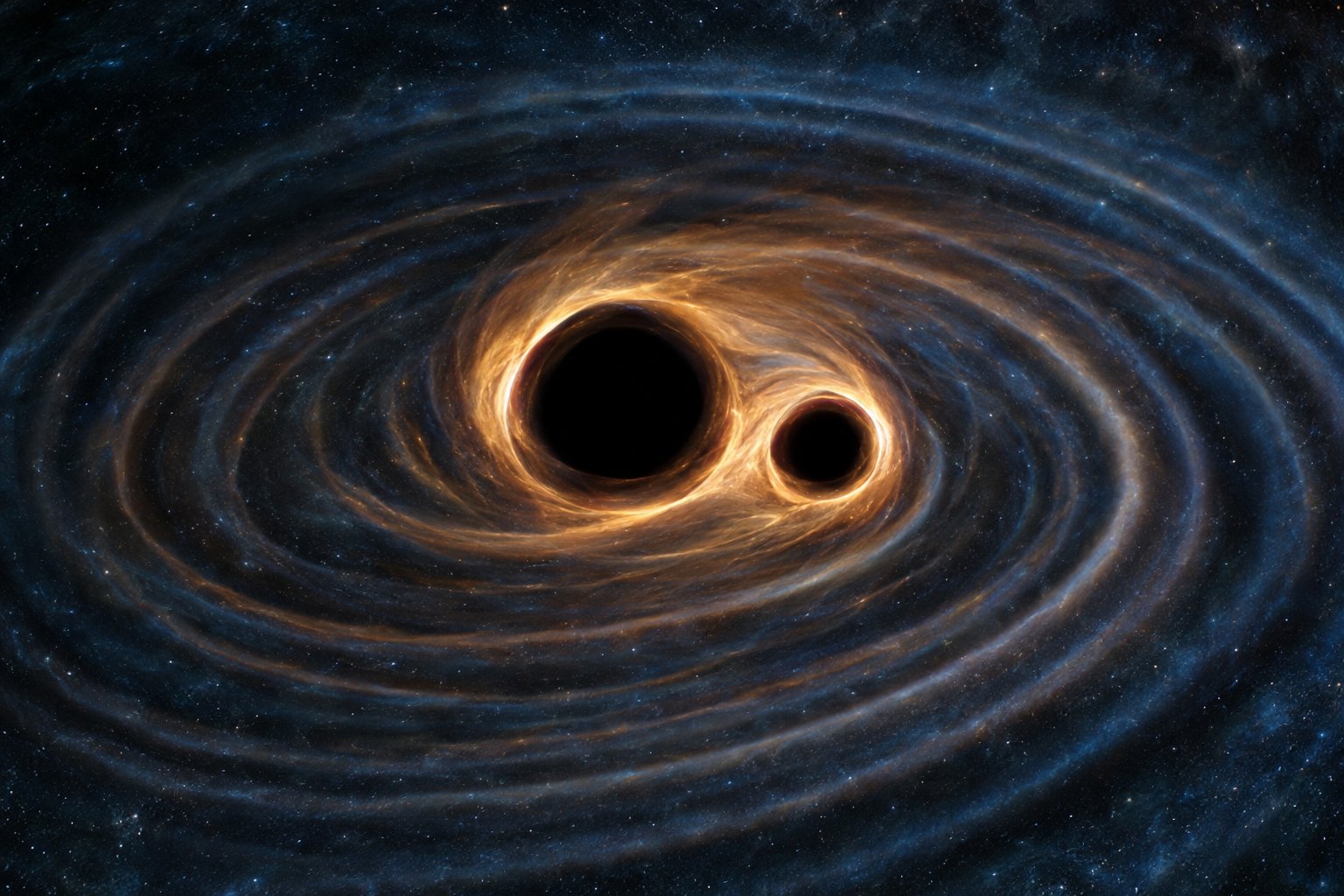
On May 12, 2026, the LIGO-Virgo-KAGRA Collaboration announced two binary black-hole systems observed during its fourth observing run: GW240925 and GW250207. Their signal-to-noise ratios were 32 and 69, respectively. The collaboration says the strength of these signals allowed an informative application of astrophysical calibration, a technique relevant to how gravitational-wave detector measurements are calibrated.
What the collaboration reported
The LIGO Scientific Collaboration’s announcement identifies the two detections as GW240925 and GW250207. It reports signal-to-noise ratios of 32 and 69, in that order, and says these high ratios allowed the first informative application of a technique called astrophysical calibration.
The announcement is accompanied by a publication titled “GW240925 and GW250207: Astrophysical Calibration of Gravitational-wave Detectors,” listed as published in Physical Review Letters. A data release for the two events is also listed through the Gravitational Wave Open Science Center.
The collaboration provides explanatory graphics about detector calibration and about the analogy between astrophysical calibration and music auto-tuning. It also includes an infographic on improving sky localization via astrophysical calibration. These materials offer ways to explore the calibration topic; the reported event figures themselves are the two signal-to-noise ratios and the observing-run identification.
Why calibration matters here
The news is not only that two binary black-hole systems were observed. The collaboration foregrounds how their signals made it possible to apply astrophysical calibration informatively. In this announcement, calibration is the connection between the detections and the method being highlighted; the source does not present a new measurement of the black holes’ masses or distances.
For readers interested in sound and data, the page also offers an animation and sonification comparing calibrated and miscalibrated waveforms for GW240925. This is a representation of waveform data, not a recording of sound travelling through space. The page says the miscalibration effect in that comparison is exaggerated by a factor of 1,000, an important caveat when interpreting the contrast.
How this fits the detection record
The collaboration’s detections page places individual announcements alongside catalog releases. It explains that the entries are ordered by announcement date rather than detection date, and that catalog releases gather multiple detections from observing runs. The page identifies GWTC-5.0, announced May 26, 2026, as a catalog release containing events from O4b and earlier observing runs.
The record stretches back to GW150914, announced on February 11, 2016, which the collaboration describes as the first direct detection of gravitational waves. Later milestones on the page include GW170817, announced October 16, 2017, the first observed binary neutron star collision and first electromagnetic counterpart; and GW200105 and GW200115, announced June 29, 2021, the first confirmed observations of neutron star–black hole binaries. Those entries show the range of systems represented in the detection history, while the May 2026 announcement focuses on calibration using two binary black-hole signals.
The collaboration says the current full catalog is available through the Gravitational Wave Open Science Center, and points readers to the GraceDB LVK Public Alerts site for an updated list of recent public alerts.
What the announcement establishes
The reported result is specific: two binary black-hole systems from the fourth observing run, with signal-to-noise ratios of 32 and 69, enabled an informative application of astrophysical calibration. The announcement and its listed publication make calibration the central point; they do not frame these detections as a resolution of broader questions about black holes.
For a reader following gravitational wave discovery news, the useful distinction is between the observed systems and the method the collaboration says their signals enabled. The accompanying waveform sonification can help make the data comparison approachable, but it remains a designed representation of waveforms—with the miscalibration effect deliberately exaggerated—not literal audio from the black-hole systems.
Source: ligo.org
More sources (1)
More from the Observatory
 Deep space and cosmology
A magnetic hollow-core jet may explain GRB 221009A’s changing signal
A China–Italy team interprets evolving gamma-ray features from GRB 221009A as possible evidence for a magnetized jet with a hollow core. The geometry remains an inference, not a direct observation of the jet’s interior.
Maya Ellison · Nov 20, 2026 · 5 min read
 Black holes
A gap in black-hole masses hints at stars that vanished without exploding
A Caltech-led analysis of 257 black-hole mergers found a shortage of objects between 12 and 16 solar masses. The pattern is consistent with a proposed failed-supernova channel, but it is not a direct observation of one.
Maya Ellison · Nov 19, 2026 · 4 min read
 Stars and galaxies
A Possible Atmosphere on TOI-431b, Seen in a Partial Eclipse
A JWST observation of the ultrahot rocky planet TOI-431b points to a possible atmosphere, but one partial eclipse cannot reveal its composition.
Maya Ellison · Nov 18, 2026 · 4 min read