
Methane and Ammonia Signals Emerge Tentatively on Beta Pictoris b
Researchers report tentative signs of methane and ammonia in the atmosphere of the directly imaged exoplanet Beta Pictoris b. The signals are weaker than those of water and carbon monoxide and still need confirmation.

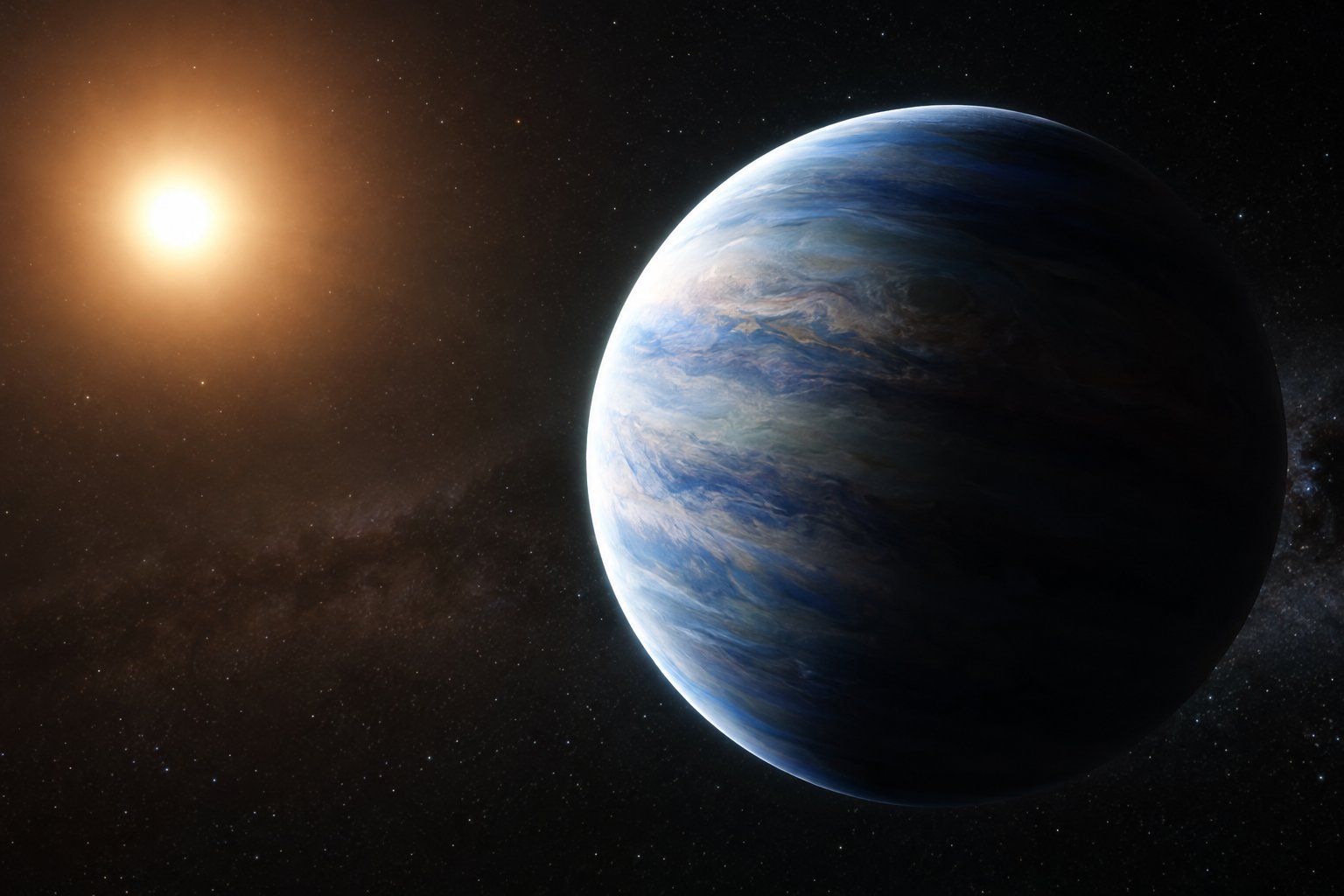
A team led by Andrea Barone reports tentative signals of methane and ammonia in the atmosphere of Beta Pictoris b, a directly imaged exoplanet orbiting the star Beta Pictoris. In a report published on 14 November 2026, Orbital Wire said a high-resolution near-infrared search found both molecules at the velocity expected for the planet. The researchers stress that these are candidate detections, not confirmed findings.
What the observations found
According to Orbital Wire, the team searched spectra collected across 44 CRIRES+ settings covering four near-infrared bands: H, K, L and M. It compared the extracted light with molecular templates using a method called cross-correlation, which looks for a matching pattern across wavelengths. The reported methane and ammonia signals had cross-correlation signal-to-noise ratios of about 5.3 and 5.7.
As a check, the researchers compared the planet’s position with an extraction at the same projected separation on the opposite side of the star. That comparison did not show a matching peak. This supports the interpretation that the candidate signals are associated with the planet’s expected position, but it does not by itself settle whether the molecules have been detected.
The same analysis recovered water and carbon monoxide, molecules detected in earlier high-resolution observations of Beta Pictoris b. Their signals were much stronger, with reported cross-correlation signal-to-noise ratios of roughly 200 for water and 50 for carbon monoxide. For the less certain molecules, the team weighted observations according to molecular information content and data quality rather than the measured strength of the candidate signal. Combining wavelengths can increase sensitivity to faint molecular patterns, the report explains.
We classify the CH4 and NH3 signals as tentative because their cross-correlation S/N values do not fully account for possible residual systematics.
Why the distinction matters
The result is notable because earlier high-resolution spectroscopy of Beta Pictoris b had found water and carbon monoxide, but not methane or ammonia. If confirmed, the new signals would mark the first detections of both species in the planet’s atmosphere, according to Orbital Wire. For now, the evidence supports a more measured conclusion: the analysis found signals consistent with methane and ammonia, while possible residual systematics remain a concern.
That difference matters when reading atmospheric results. A signal-to-noise value describes the measured signal in relation to noise in the data; it is not, on its own, a guarantee that a candidate detection is secure. The much stronger water and carbon monoxide results provide a useful comparison within the same analysis, but the weaker candidate peaks need further scrutiny before they can be treated as confirmed detections.
Background: a directly imaged planet
Beta Pictoris b is a directly imaged planet in the Beta Pictoris system. Orbital Wire describes the system as a valuable setting for studying planets because it is relatively young and nearby; it reports an age of about 24 million years and a distance of 19.7 parsecs. The star is also known to host multiple directly imaged planets. Beta Pictoris b itself was directly imaged in 2008.
The present finding concerns molecular signals in the planet’s atmosphere, not a direct image of methane or ammonia. The researchers infer candidate molecules from patterns in the planet’s spectrum. This distinction keeps the observation clear: the evidence is spectroscopic, and the interpretation of the weaker signals remains tentative.
What to watch next
Orbital Wire reports that the paper, led by Barone and co-authors, has been accepted for publication in Astronomy & Astrophysics. The key scientific question is whether follow-up analysis or observations can establish that the methane and ammonia signals are not explained by residual systematics. Until that uncertainty is resolved, the molecules should be described as tentative candidates rather than confirmed atmospheric detections.
Source: orbital-wire.com
More from the Observatory
 Black holes
A gap in black-hole masses hints at stars that vanished without exploding
A Caltech-led analysis of 257 black-hole mergers found a shortage of objects between 12 and 16 solar masses. The pattern is consistent with a proposed failed-supernova channel, but it is not a direct observation of one.
Maya Ellison · Nov 19, 2026 · 4 min read
 Stars and galaxies
A Possible Atmosphere on TOI-431b, Seen in a Partial Eclipse
A JWST observation of the ultrahot rocky planet TOI-431b points to a possible atmosphere, but one partial eclipse cannot reveal its composition.
Maya Ellison · Nov 18, 2026 · 4 min read
 Deep space and cosmology
SN Ares: JWST finds a supernova whose next images may take decades
JWST observations reveal the lensed Type IIb supernova SN Ares. Models predict two more images decades from now, but those arrivals—and their timing—remain to be observed.
Maya Ellison · Nov 17, 2026 · 4 min read