
Mars May Be Dormant, Not Geologically Dead, ESA Reports
The ExoMars Trace Gas Orbiter detected localized hydrogen chloride above fissures on Alba Mons. Researchers say the finding could point to dormant volcanism, but it is not evidence of an observed eruption or life.

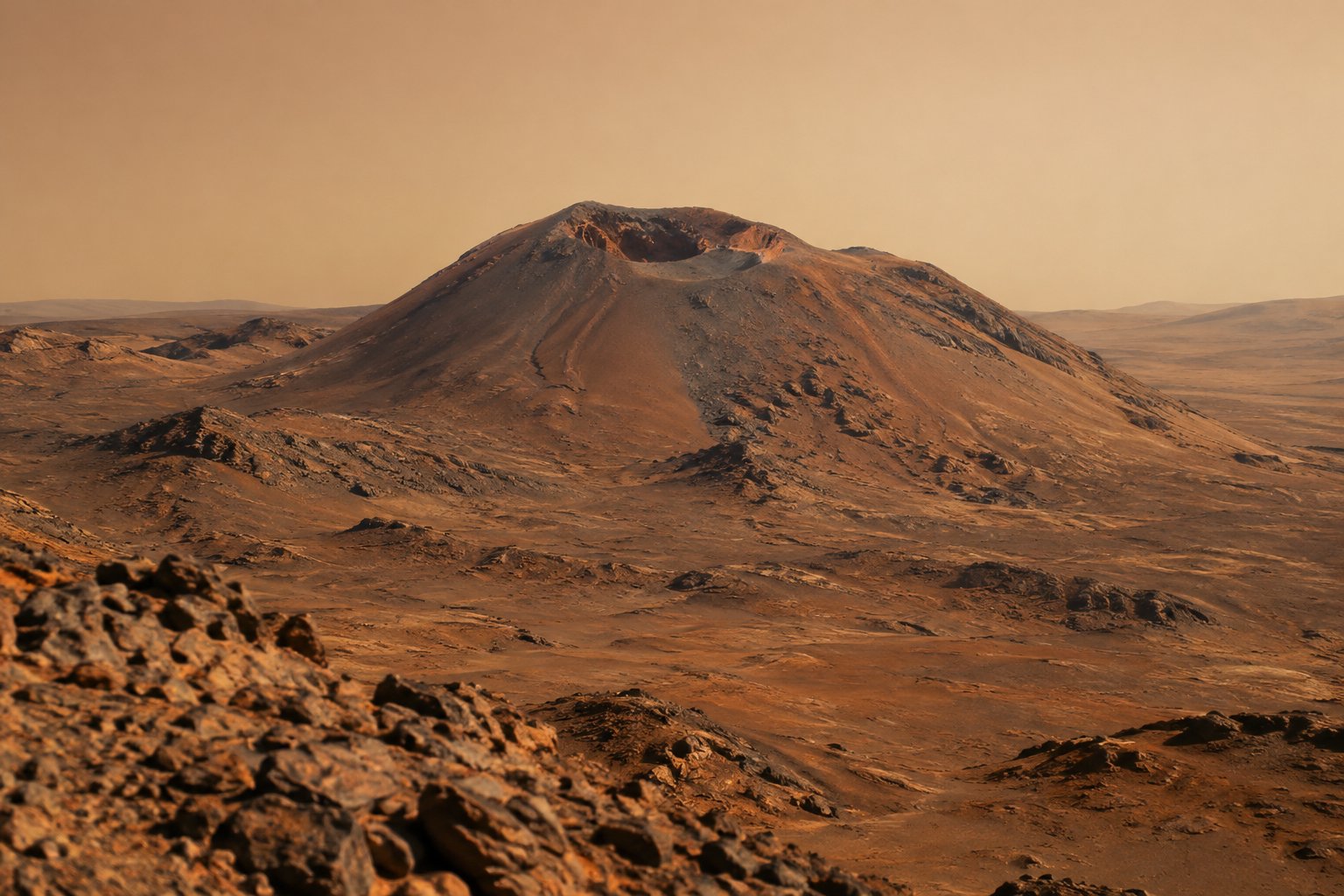
On 4 November 2026, the European Space Agency (ESA) reported evidence that Mars may not be geologically dead: its ExoMars Trace Gas Orbiter (TGO) detected hydrogen chloride concentrated above volcanic fissures on Alba Mons. Researchers interpret the gas as a possible sign of dormant volcanism, with material from beneath the Martian surface seeping upward. The finding points to a possible source of recent or ongoing geological activity, not an observed eruption.
What the orbiter detected
According to ESA, researchers noticed hydrogen chloride spikes in the Martian atmosphere during early summer in the planet’s northern hemisphere, in a location where the gas’s usual seasonal pattern did not predict them. Hydrogen chloride generally reaches its maximum in northern-hemisphere winter and mostly disappears in summer. ESA says much of that cycle appears connected to Mars’ water and dust cycles. The exception was repeatedly localized above fissures on Alba Mons during early summer.
TGO’s Atmospheric Chemistry Suite, which uses infrared spectrometers, detected the gas. ESA reports that the orbiter’s CaSSIS camera then showed fresh, narrow fissures in the Alba Mons region, in some cases hundreds of metres long, associated with surface colour changes. Space.com also reported that TGO detected hydrogen-chloride-containing gas making its way to the surface through the fissures.
The researchers propose that gas rises from inside Mars and becomes trapped by ice during winter. As the ice sublimates—changing directly from solid to gas—the trapped material may escape in early summer. ESA says the fissures’ discolouration could come from deposits left by escaping gases. These are proposed explanations for the observations, rather than a direct view of magma moving underground.
Our findings suggest that Mars has retained enough internal heat to support volcanic activity until recently, and possibly still does
Why the interpretation matters—and what it does not show
Hydrogen chloride is commonly found escaping from magmatic vents on Earth, according to ESA and Space.com. Its presence above Martian fissures therefore gives researchers a possible link between the atmosphere and processes beneath the surface. ESA says an international team led by Alexander Trokhimovskiy interprets the release as coming from hot magma below ground; the team suggests that the seepage may connect to a dormant magma chamber, a kind of underground volcanic plumbing system.
The evidence is indirect: the orbiter measured gas in the atmosphere and imaged fissures and surface changes. ESA reports no newly observed lava flows or eruptions. The observations support investigating a volcanic explanation, but do not establish that an eruption is under way or that the proposed magma chamber is active now.
The team also raises a possible connection to the search for past or present habitable environments. ESA and Space.com describe how magmatic gases may have contributed to a thicker, warmer ancient atmosphere, and how lava meeting groundwater could create warm environments. Mège says fissures could be worth considering in the search for life if hydrothermal systems are active. That is a conditional possibility: the reported observations do not detect microorganisms or confirm an active hydrothermal system.
Background: signs of activity, but no observed eruption
Mars has often been described as geologically inactive, but earlier observations have left the question open. ESA reports that orbital imagery shows some volcanoes may have been active within the last few million years, while seismometers have detected marsquakes. Both are reasons to consider possible volcanic activity, but neither is an observed eruption. ESA notes that new lava flows or eruptions have not been observed.
The gas itself was first reported in Mars’ atmosphere by TGO in 2021, according to ESA. The unusual seasonal spikes prompted researchers to look more closely at where and when it appeared, then compare those observations with the geological features of Alba Mons. Space.com notes that Alba Mons is in the Tharsis region, the same broad region as Olympus Mons. The research paper, “Enigmatic HCl detections as a potential signature of igneous activity on Mars,” was published in Science Advances on 4 November 2026, according to ESA.
What to watch next
The central question raised by the study is whether the seasonal gas release is a reliable sign of volcanic processes beneath Alba Mons—and whether those processes may still be active. The researchers’ explanation depends on connecting the atmospheric detections with the fissures and on excluding other possible chemical processes in Mars’ atmosphere. Mège told Space.com that examining those alternatives was a major part of the work.
For readers following the result, the important distinction is between a measured signal and its interpretation: TGO detected localized hydrogen chloride, while dormant volcanism is the researchers’ explanation for the pattern. The study adds evidence to a question already raised by imagery and marsquakes; it does not settle how active Mars is today or establish that the fissures contain life.
Source: esa.int
More sources (1)
More from the Observatory
 Deep space and cosmology
A magnetic hollow-core jet may explain GRB 221009A’s changing signal
A China–Italy team interprets evolving gamma-ray features from GRB 221009A as possible evidence for a magnetized jet with a hollow core. The geometry remains an inference, not a direct observation of the jet’s interior.
Maya Ellison · Nov 20, 2026 · 5 min read
 Black holes
A gap in black-hole masses hints at stars that vanished without exploding
A Caltech-led analysis of 257 black-hole mergers found a shortage of objects between 12 and 16 solar masses. The pattern is consistent with a proposed failed-supernova channel, but it is not a direct observation of one.
Maya Ellison · Nov 19, 2026 · 4 min read
 Stars and galaxies
A Possible Atmosphere on TOI-431b, Seen in a Partial Eclipse
A JWST observation of the ultrahot rocky planet TOI-431b points to a possible atmosphere, but one partial eclipse cannot reveal its composition.
Maya Ellison · Nov 18, 2026 · 4 min read