
LOFAR’s sharpest low-frequency view reveals 63,000 radio sources
A Leiden-led team’s image of ELAIS-N1 has twenty times the resolution of LOFAR’s previous view, showing radio sources from quasars to star-forming galaxies.

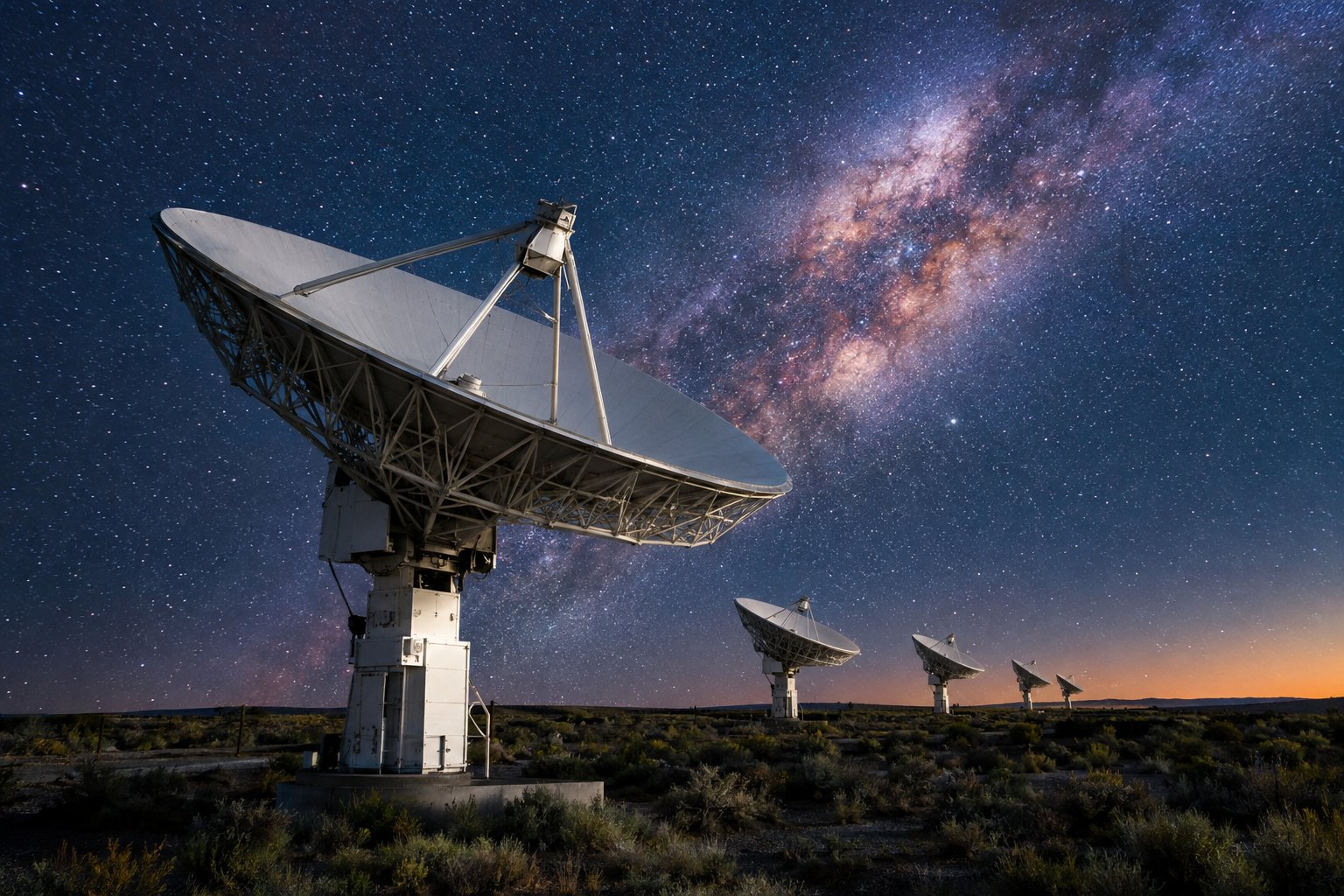
A Leiden University-led international team has produced the deepest low-frequency radio image of the sky to date, reporting 63,000 sources in a view with twenty times the resolution of LOFAR’s previous image. Orbital Wire reported the result on November 13, 2026. The team used the Low Frequency Array (LOFAR) to observe ELAIS-N1, a region in the northern sky.
What the team produced
The image brings together radio emissions from 63,000 sources, including quasars and galaxies forming stars, according to the research team as reported by Orbital Wire. It contains 8 billion pixels and was made from 200 hours of telescope observations and 400 terabytes of data. The improvement is not simply a closer look at a few objects: the higher resolution allows individual radio sources and large jets to be distinguished more clearly than in earlier, lower-resolution surveys.
The leap depended on interferometry: linking signals collected by multiple telescopes to make a sharper image. LOFAR’s stations are spread across Europe, with the farthest nearly 2,000 kilometres apart. Combining their observations requires correcting for distortions introduced by Earth’s ionosphere, the electrically charged layer in the upper atmosphere. Orbital Wire reported that Dr. Cyril Tasse of the Paris Observatory led work on algorithms to address those distortions.
Why the added detail matters
The sharper view helps researchers investigate how radio jets interact with their surroundings and change over cosmic time. In lower-resolution surveys, distant galaxies and their jets could appear as indistinct blobs, making it difficult to tell individual galaxies from clusters. The new image makes more of that structure visible, creating opportunities to study the sources separately.
Orbital Wire reported that LOFAR’s sensitivity revealed filaments around radio galaxies, particularly near galaxy clusters, as well as details of their structure and spectral characteristics. Reaching that level of detail required combining high-resolution observations with low-frequency data. The array is also suited to detecting extended low-frequency radio emissions from active galactic nuclei, the bright central regions of some galaxies.
Quasars are especially prominent in the image. The research team describes them as bright galaxy centres powered by supermassive black holes. Their accretion disks—the disks of material around the black holes—produce jets that travel at relativistic speeds and emit radiation. The image provides a way to examine these radio-emitting structures; it does not, by itself, establish the distance or mass of each source.
Another major population is small, young galaxies with high rates of star formation, the team reported. Radio waves can pass through gas and dust that obscure visible and infrared light. That makes radio observations useful for investigating star formation in these galaxies and studying how early-Universe galaxies developed into larger spiral and elliptical systems.
How this fits into LOFAR’s wider survey
ELAIS-N1 has been observed by LOFAR for years as part of efforts to map low-frequency radio sources. Orbital Wire describes it as a northern-sky region with little dust, gas or stars. The new image is a high-resolution view of that field, while LOFAR’s wider survey work has mapped sources across the radio sky.
A separate LOFAR collaboration published LoTSS-DR3 on February 19, 2026. Orbital Wire reported that this detailed radio-sky map contains 13.7 million cosmic sources and represents the most complete count yet of actively growing supermassive black holes. The report says the release drew on more than ten years of observations, processing and analysis, and required more than 20 million core hours of computing time. The Leiden-led ELAIS-N1 image is not the same dataset or survey release; it demonstrates what newer processing methods can achieve when survey observations are imaged at much higher resolution.
Radio maps offer a different view from optical images because they trace emission that can be produced by relativistic particles moving through magnetic fields. To estimate properties such as the distance and mass of individual radio sources, the radio data need to be considered alongside observations of the same region at optical, infrared and X-ray wavelengths. Those additional observations help characterize what the radio sources are and where they lie.
What researchers will pursue next
The reported image is a result about the detail researchers can extract from radio observations, not a final account of every source in the field. Combining the radio data with observations at other wavelengths is an important next step for determining source properties. Researchers can also use the resolved structures to investigate how jets affect their environments and evolve.
The team says the work demonstrates LOFAR’s potential as it undergoes an upgrade to LOFAR2.0. ASTRON and European partners are developing the upgraded telescope to produce wider, higher-resolution images, with a two-fold increase in survey speed. Orbital Wire also reported that the LOFAR collaboration plans to build on LoTSS-DR3 and that new processing methods are making higher-resolution imaging of survey data practical. These efforts are intended to keep LOFAR competitive with next-generation facilities, including the Square Kilometre Array.
For readers following black-hole and galaxy research, the key distinction is between what this image resolves and what further observations must establish: it reveals radio sources and structures in exceptional detail, while identifying their distances, masses and broader histories depends on analysis across wavelengths.
Source: orbital-wire.com
More from the Observatory
 Black holes
A gap in black-hole masses hints at stars that vanished without exploding
A Caltech-led analysis of 257 black-hole mergers found a shortage of objects between 12 and 16 solar masses. The pattern is consistent with a proposed failed-supernova channel, but it is not a direct observation of one.
Maya Ellison · Nov 19, 2026 · 4 min read
 Stars and galaxies
A Possible Atmosphere on TOI-431b, Seen in a Partial Eclipse
A JWST observation of the ultrahot rocky planet TOI-431b points to a possible atmosphere, but one partial eclipse cannot reveal its composition.
Maya Ellison · Nov 18, 2026 · 4 min read
 Deep space and cosmology
SN Ares: JWST finds a supernova whose next images may take decades
JWST observations reveal the lensed Type IIb supernova SN Ares. Models predict two more images decades from now, but those arrivals—and their timing—remain to be observed.
Maya Ellison · Nov 17, 2026 · 4 min read