Latest JWST Discoveries: A Distant Radio Burst, an Early Galaxy and Dust Near the Milky Way’s Black Hole
Webb observations connect a far-off fast radio burst to a small young galaxy, confirm an early-universe galaxy and reveal dust and water around a star near Sagittarius A*.

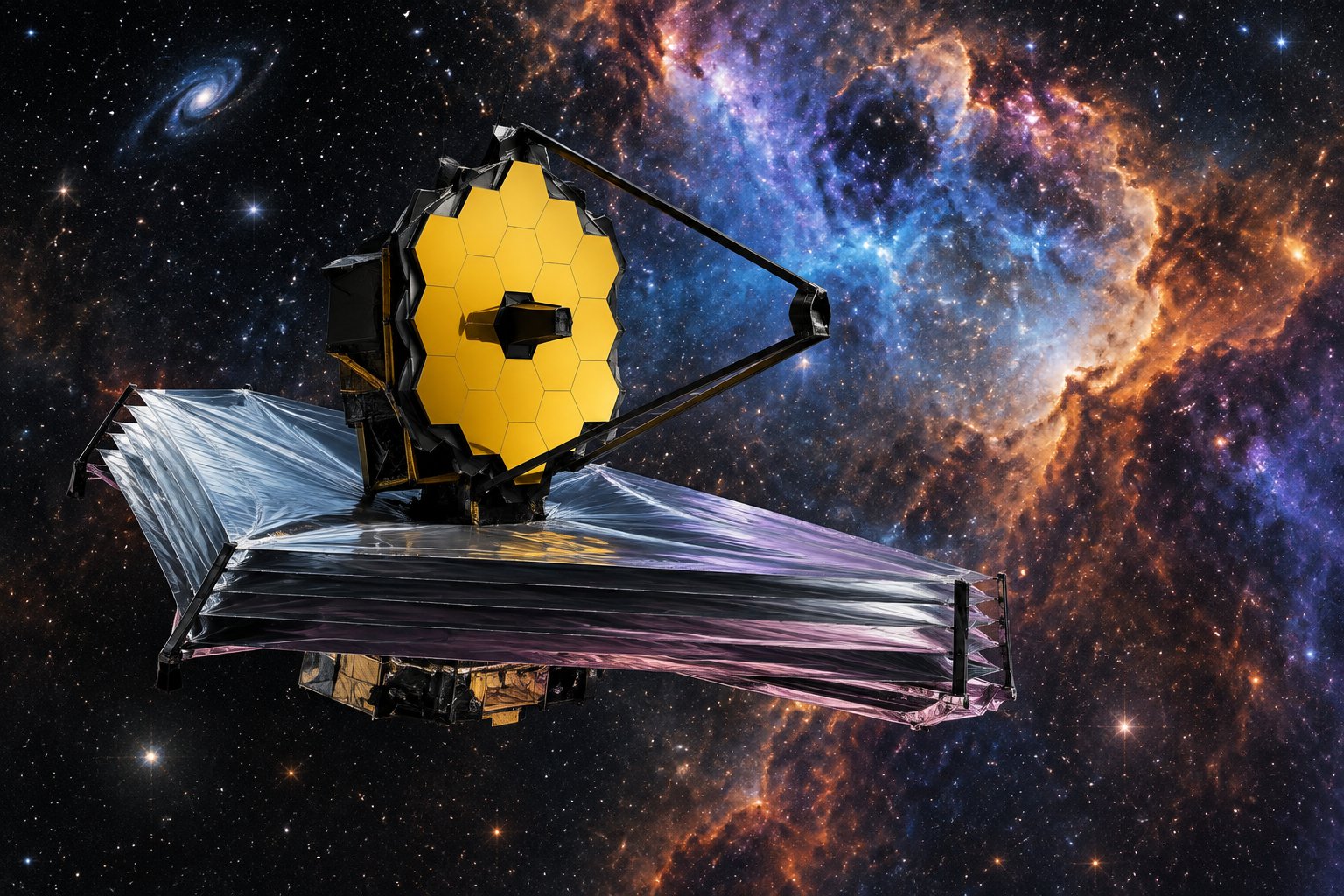
Recent James Webb Space Telescope (JWST) observations have sharpened the picture of three very different cosmic environments: a galaxy hosting a record-distant fast radio burst, an early galaxy seen 280 million years after the Big Bang, and a star shedding dust and water close to the Milky Way’s central black hole. NASA’s account of the early galaxy MoM-z14 is dated 28 January 2026; ESA reports the other findings, including Webb’s study of the burst FRB 20240304B and the star IRS 3.
What Webb observed
A fast radio burst in a surprisingly small host
ESA reports that the MeerTRAP team detected FRB 20240304B with the MeerKAT radio telescope on 4 March 2024. A fast radio burst, or FRB, is a brief flash of radio emission. Because the signal suggested an extreme distance and ground-based telescopes could not see a galaxy at its precisely determined position, the team used Webb to identify and examine the host.
Webb’s Near-Infrared Camera, NIRCam, detected the galaxy, and its Near-Infrared Spectrograph, NIRSpec, measured a redshift of 2.148. Redshift describes how the expansion of the Universe stretches light toward longer, redder wavelengths; a greater redshift generally indicates that light has travelled farther. ESA reports that this galaxy dates to about 3 billion years after the Big Bang. It is 1,000 times less massive than the team expected and was actively forming stars.
The host’s youth and small size are evidence consistent with a possible origin in a young, highly magnetic neutron star called a magnetar. Such a star could produce a burst relatively soon after its massive predecessor exploded. A competing proposal is that FRBs can result from two neutron stars merging, a process expected to take billions of years. The team says a merger is very unlikely for this particular burst, but the origin of FRBs remains unsettled. ESA reports the Webb host-galaxy measurement.
ESA also reports that the burst’s signal carries information about material along its path. The team identified two intervening structures: a previously unknown galaxy cluster at redshift 0.3, described as about 3.5 billion light-years from Earth, and the Virgo Cluster, about 54 million light-years away.
A galaxy from the Universe’s first 300 million years
NASA reports that Webb confirmed MoM-z14 with a redshift of 14.44, measured using NIRSpec. The galaxy existed 280 million years after the Big Bang. NASA describes its light as having travelled through expanding space for about 13.5 billion years, within a Universe estimated to be 13.8 billion years old.
MoM-z14 belongs to a growing group of bright galaxies found in the early Universe. The research team says these galaxies are about 100 times more numerous than theoretical studies predicted before Webb launched. MoM-z14 also shows unusually high nitrogen enrichment. NASA reports that the time available for generations of stars to produce the observed nitrogen is limited; one proposed explanation is that dense conditions in the early Universe enabled supermassive stars to form. That remains an interpretation, not an established account of how the galaxy acquired its chemistry.
The observations also show signs that MoM-z14 may be clearing surrounding primordial hydrogen. This relates to reionization, the period when energetic light from early stars began breaking through the hydrogen gas that had filled the young Universe. The galaxy offers another clue to that period, not a complete timeline. NASA’s report describes MoM-z14 and its measured redshift.
Dust and water beside the Galactic centre
In a separate result, ESA reports that Webb’s Mid-Infrared Instrument, MIRI, observed IRS 3, an evolved star 0.55 light-years from Sagittarius A*, the supermassive black hole at the centre of the Milky Way. The observations were made in 2025 through the MICONIC programme.
By analysing the star’s infrared light, researchers identified signatures of oxygen-rich silicate dust and detected water in the star’s surrounding envelope. ESA describes this as the first clear detection of water for this object. Modelling of the envelope indicates a layered distribution of dust extending roughly 10,000 astronomical units from the star, with estimated temperatures falling from about 1,200 kelvin near the star to about 100 kelvin in the outer regions. The researchers estimate IRS 3 has about six solar masses and is around 72 million years old.
The result indicates that material can persist and form around an evolved star in this harsh setting. It does not mean the black hole itself produced the dust or water: the observations concern material shed by IRS 3. ESA details Webb’s observations of IRS 3.
Why these findings matter
Together, the results show how Webb’s infrared instruments can help researchers study objects that are faint, distant or embedded in dusty environments. The radio burst illustrates how one brief signal can serve as a probe of both its host galaxy and intervening cosmic structures. The MoM-z14 spectrum gives researchers a more secure distance measurement than an estimate based on images alone. At the Milky Way’s centre, the IRS 3 observations reveal that a star can contribute dust and molecular material even in a region exposed to intense radiation.
For readers following black-hole research and cosmic origins, the distinction between measurement and explanation is central. Redshifts, spectral signatures and observed light provide evidence; proposed FRB engines and explanations for MoM-z14’s nitrogen remain questions for further study. These findings add constraints and clues, rather than resolving every open question about the early Universe or extreme environments.
Background and context
FRBs were first discovered in 2007, ESA reports. They last milliseconds, and many have been seen only once, making it difficult to determine what creates them. For FRB 20240304B, radio observations established its position and suggested great distance; Webb’s observations of the host supplied the redshift measurement needed to confirm that distance.
At the other end of cosmic history, Webb’s observations of early galaxies are testing expectations about how quickly stars and galaxies formed and how the young Universe changed. NASA notes that identifying a galaxy in images is not the same as confirming its distance: spectroscopy measures how its light has been shifted. Its report also says MoM-z14 shares nitrogen enrichment seen in some ancient stars in the Milky Way, while the reason for that enrichment in such an early galaxy remains open.
IRS 3 is in the asymptotic giant branch phase, a late stage of stellar life in which a star is large, cool and luminous and sheds gas through stellar winds. ESA says earlier studies had suggested the star might be carbon-rich; Webb’s silicate signatures instead identify it as oxygen-rich. The new spectrum therefore changes the picture of the star’s chemistry as well as documenting material in its envelope.
What to watch next
The FRB team says MeerKAT may be able to detect and localise several bursts per year at redshifts greater than 1.0. ESA reports that additional radio facilities and instruments could increase the pace, while Webb will be important for characterising the host galaxies. More distant examples could help test whether the young-magnetar interpretation applies broadly or whether multiple kinds of events produce FRBs.
For MoM-z14, NASA points to the need for more detailed Webb observations and a larger sample of early galaxies to identify which features are common. NASA says the Nancy Grace Roman Space Telescope is expected to expand the sample of bright, compact, chemically enriched early galaxies. Further observations will help researchers assess explanations for their brightness and nitrogen enrichment and refine the timeline of reionization.
The IRS 3 findings were reported as published in Astronomy and Astrophysics; the FRB study was reported as published in Science. Those studies and future observations will provide the next evidence for assessing how stars, bursts and galaxies behave in environments that Webb is only beginning to characterise.
Source: esawebb.org
More sources (2)
More from the Observatory
 Black holes
A gap in black-hole masses hints at stars that vanished without exploding
A Caltech-led analysis of 257 black-hole mergers found a shortage of objects between 12 and 16 solar masses. The pattern is consistent with a proposed failed-supernova channel, but it is not a direct observation of one.
Maya Ellison · Nov 19, 2026 · 4 min read
 Stars and galaxies
A Possible Atmosphere on TOI-431b, Seen in a Partial Eclipse
A JWST observation of the ultrahot rocky planet TOI-431b points to a possible atmosphere, but one partial eclipse cannot reveal its composition.
Maya Ellison · Nov 18, 2026 · 4 min read
 Deep space and cosmology
SN Ares: JWST finds a supernova whose next images may take decades
JWST observations reveal the lensed Type IIb supernova SN Ares. Models predict two more images decades from now, but those arrivals—and their timing—remain to be observed.
Maya Ellison · Nov 17, 2026 · 4 min read